 Back

Musical Form: How Composers Shape a Piece with Binary, Ternary, Rondo, and Sonata
Pick up any page of classical piano music and your eyes see a stream of notes. But your ears hear something different: sections that come back, sections that contrast, a home that gets left and found again. The letters composers and analysts write above the staff — A, B, A′ — are a map of the whole piece. Learning to read that map does not just help you study music; it cuts memorization in half and makes every practice session smarter.
This guide takes you from the smallest building block (the motif) all the way up to sonata form, the architecture behind hundreds of Classical sonatas and sonatinas. By the end, you will have a toolkit for opening any score and writing a single line of letters that describes what it does.
Motifs, phrases, and sections: the building blocks
Before you can map a piece, you need to know what the pieces are. Music is built in a hierarchy, from the very small to the very large.
A motif is a short idea — often just two to five notes — with a distinctive rhythm or shape. It is the smallest unit that can be recognized when it comes back. The two opening notes of Beethoven's Für Elise, E and D♯ rocking back and forth, are a classic example: they appear over and over in a hundred different ways throughout the piece. Motif and sequence shows you how to spot a motif and what composers do with it — repeat it on the same notes, transpose it up or down (a sequence), invert it, or stretch it into longer note values.
A phrase is a musical sentence, most often four bars long, that ends with a cadence. The cadence is the punctuation: a phrase ending on the dominant (V) sounds like a question, and one that falls V→I sounds like a period. Two phrases linked as question and answer form a period. Phrase and period covers antecedent and consequent phrases with an original example in Classical style and the opening of Beethoven's "Ode to Joy."
A section is several phrases long. The Musical form handout puts the naming rule in one line: same music gets the same letter, music that returns changed gets A′ ("A prime"), and new music gets the next letter, B. Repeat signs do not change the letter — a repeated A is still A. Capital letters name sections of a full piece; small letters name the phrases inside a single tune.

From motif to period: the building blocks that stack into sections. A motif is a short idea with a recognizable shape; a phrase is a musical sentence ending in a cadence; two phrases form a period.
With those three terms in hand, you are ready to look at the forms themselves. Each one is essentially an answer to the question: does the opening section come back, and how many times?
Binary form (AB): two halves
The simplest full-length form has two halves, each repeated. Write it ‖:A:‖:B:‖ — the double bars with dots mean play each half twice. A ends with a cadence (often on the home chord or the dominant), B often moves to a related key and then comes home.
The critical test is what happens at the border between A and B, and at the end. In pure binary form A does not return as a whole after B ends. The piece closes with new material, or with material that nods to A without fully restating it.

Binary form ‖:A:‖:B:‖. Each half is repeated. A stays in the home key (I); B often visits the dominant (V) or another key before cadencing home.
The Minuet in G by Christian Petzold — long printed as "Bach's Minuet in G" until scholars found the true author in 1979 — is one of the most-played examples. Its 32 bars fall into two 16-bar halves. The first stays in G major and ends there; the second visits D major (the dominant, V) before returning home. At bar 25, the opening drop from D to G reappears for one beat, but the tune itself does not return: B closes differently. That single detail makes it binary rather than rounded binary. Inside the Minuet in G walks you through both halves bar by bar.
Binary form is two halves and no return. If the opening tune comes back inside the second half, the form has a different name.
The Binary, rounded binary & ternary handout has a key-color map of the Minuet showing exactly where G major ends and D major begins.
Rounded binary (ABA′): the return inside B
Rounded binary starts like binary — ‖:A:‖:B A′:‖ — but the opening tune comes back inside the second half, changed just enough to end on the home chord instead of the dominant.
A stops on V: a half cadence, like a question. After B introduces contrasting material, A′ replays the opening but rewrites its last bars so it reaches I: an authentic cadence, the full stop. Because both B and A′ are inside the second repeated half, the written repeat means you hear the scheme as A, A, B A′, B A′.

Rounded binary: ‖:A:‖:B A′:‖. A stops on V; A′ replays the opening but lands on I. B and A′ share the second repeated half.
Schumann's "The Happy Farmer" (from Album for the Young) demonstrates the shape cleanly. The opening eight bars return at bar 11 with a changed ending that lands on the home chord instead of the dominant. The Binary, rounded binary & ternary handout labels every bar of The Happy Farmer with this exact structure, and the Label the form exercise asks you to identify the form of Burgmüller's Arabesque, which uses the same scheme.
Rounded binary is the direct ancestor of sonata form: when composers in the mid-1700s stretched B into a full development and made A′ a complete recapitulation, the larger structure emerged.
Ternary form (ABA): three separate sections
Ternary form has three sections: A, then a contrasting middle (B), then A again — but here B is a complete section of its own, not just a few introductory bars before the return. The difference from rounded binary comes down to two questions, as the Binary, rounded binary & ternary handout puts it: does the middle section close in its own key (or at least stand as an independent unit), and does all of A come back — not just its ending?

Ternary form ABA. B is a self-contained section in a contrasting key or character. The final A is a complete return, not just A's ending.
Schumann's "The Wild Rider" (also from Album for the Young) is the textbook example. Its A section is a driving gallop in A minor. B is the same galloping rhythm a tenth lower, now in F major and in the left hand — the contrast comes from the key and the register, not an entirely new tune. B closes in F. Then bars 17–24 repeat bars 1–8 exactly: a complete return of A in A minor. Three sections, each one closed: ABA.
A da capo direction produces the same shape on the page from what looks like two halves. The Musette in D (Christian Petzold, also from the Anna Magdalena Notebook) is printed as two repeated sections. At the end, "D.C. al Fine" sends you back to the start and stops at bar 8. So the whole piece plays A B A: ternary. A minuet and trio works identically — the Trio is B, and "D.C." brings the Minuet (A) back. That is why a Minuet and Trio is listed as ternary even though the written page looks like binary.
Rondo (ABACA and beyond): the refrain that keeps returning
In rondo form one section — the refrain, A — keeps coming back, with a new episode (B, C, D…) between each return. Write the most common Classical version as ABACA; a longer Baroque rondeau might run ABACADA. The refrain is typically in the home key; each episode moves to a different key or introduces new melodic material.

Rondo ABACA. The refrain (A) always returns in the home key. Each episode (B, C) visits a contrasting key or character before A is called back.
The clearest piano example for students is Beethoven's Für Elise. The famous opening tune in A minor is the refrain; it comes back at bar 39 and again at bar 83. Between its first and second returns is episode B (bars 24–38), a sunny tune in F major; between the second and third returns is episode C (bars 61–82), a darker, restless passage over a drumming low A. The whole plan: A B A C A, a textbook ABACA rondo. Inside Beethoven's Für Elise maps every section with bar numbers, and Label the form asks you to verify the form yourself.
Classical rondo finales by Haydn and Mozart typically follow ABACABA — a seven-block plan where B returns once after C, so the second half mirrors the first. Mozart's Piano Sonata in C, K. 545 ends with a Rondo movement in this pattern, with C major as the home and G major as the key of B.
The difference between a rondo and a strophic or ternary piece is the number of returns. If A comes back once at the end, that is ternary (or rounded binary). If it comes back again and again, with new music between each return, that is rondo.
Theme and variations (A A¹ A² A³…): one idea, many costumes
Theme and variations is the form where a complete theme comes first and is then repeated multiple times, each time transformed. The theme stays recognizable — usually its length, its harmonic skeleton, and often its melody are preserved — but the texture, rhythm, register, or mode changes with every variation.

Theme and variations. Every block is the same length as the theme. Each variation keeps the harmonic skeleton but transforms the texture, rhythm, or register.
Mozart's 12 Variations on "Ah, vous dirai-je, maman," K. 265, starts from the tune of "Twinkle, Twinkle, Little Star" and runs through twelve variations that touch on rapid passages, minor mode, a slow Adagio, and a final Allegro. The Musical form handout includes a sample variation in this spirit: the same eight-bar theme in C major, with the original melody notes kept on the strong beats while new notes fill the gaps. Try playing the theme first, then the variation on the sheet, then invent your own — put the theme in half notes, or in C minor.
Theme and variations can be an entire movement (Beethoven's Piano Sonata Op. 109 ends with six variations) or a complete short piece. It is distinct from the other forms because A never yields to B: every variation is a transformation of A, not a contrast to it.
Sonata form: two themes, two keys, one homecoming
Sonata form is the largest and most elaborate single-movement structure in the Classical style. The Sonata form handout summarizes it in one sentence: two themes, two keys, one homecoming. The plan has three named parts: the exposition, the development, and the recapitulation, with an optional coda.

Sonata form: Exposition (Theme 1 at home, bridge, Theme 2 in the dominant V) — Development (ideas worked over, often in minor keys) — Recapitulation (both themes in the home key). An optional coda follows.
The exposition
Theme 1 opens in the home key and establishes the tonal center. A bridge follows — a passage that modulates and builds energy — leading to Theme 2 in a new key. In a major-key piece, Theme 2 arrives in the dominant (V); in a minor-key piece, it usually arrives in the relative major (III). A closing section confirms the new key with one or more cadences. The whole exposition is typically repeated.

The exposition in detail. Theme 1 settles in I; the bridge modulates; Theme 2 arrives in V (or III in minor); closing confirms V.
The contrast between the two themes can be melodic (lyrical versus energetic), rhythmic, or simply the contrast of key. In Mozart's Sonata in C, K. 545, Theme 1 is a bright rising scale figure in C major; Theme 2's melody enters in bar 14 (the section begins at bar 13) in G major with a singing melody in the right hand — the F♯ gives it away instantly. Inside Mozart's Sonata in C, K. 545 has the bar numbers and score excerpts for every section.
The development
The development takes material from the exposition — a fragment of Theme 1, the head of Theme 2, a figure from the bridge — and works it over: sequences it through new keys, inverts it, splits it between the hands, strips it down to its motif. Chromatic and minor-key passages are common. The development usually ends by sitting on the dominant (V), building anticipation for the recapitulation.
The recapitulation
The recapitulation brings Theme 1 back, usually in the home key. The bridge is modified so it stays in the home key rather than modulating away. The key result: Theme 2 returns in the home key (I). That is the homecoming the form is built around — the moment when a theme you heard "away" in the dominant finally comes back "home."
In Mozart's K. 545, bars 58–66 replay bars 13–21 — the same right-hand melody, now a fifth lower, in C instead of G. Clementi's Sonatina in C, Op. 36 No. 1 follows exactly the same plan: Theme 2 appears in G at bar 8 and comes home to C at bar 31. Inside Clementi's Sonatina in C and the Sonata Detective exercise let you hear both moments back to back.
A coda may follow the recapitulation — a short extension that confirms the home key, sometimes with a final reference to Theme 1 or a new flourish, and then a cadential close.

The recapitulation in detail. The bridge is rewritten to stay in I. Both themes now sound in the home key: the homecoming.
Is it sonata form? Three questions
The Sonata form handout gives three questions in order:
- Does Theme 2 appear in a new key in the exposition?
- Is there a development section?
- Does Theme 2 come back in the home key in the recapitulation?
Three yeses: sonata form. If only the second question says no, the movement is sometimes called shortened sonata form. The Moderato movement of the Sonatina in G (attributed to Beethoven, Anh. 5) is a useful contrast: it keeps both its main idea and its contrasting passage in G major throughout, so question 1 says no. Its form is ABA with a coda — ternary, not sonata form. Inside the Sonatina in G explains the distinction.
How to label a piece by ear or by score
You do not need to identify every note to map a piece's form. The Label the form exercise teaches a step-by-step listening method, and the Binary, rounded binary & ternary handout gives a decision tree. Here is how to work through any piece:
- Listen for the first section. Where does it feel complete? That is the end of A. Note the bar number and the key.
- Listen for change and return. The next new block is B (or the development). When something familiar comes back, that is a return of A (or the recapitulation).
- Count the returns. One return at the end, with no other new sections: ternary or rounded binary. A return keeps coming back with new music between: rondo. No return: binary.
- Apply the three questions. If there is a return, check whether Theme 2 moved to a new key: if yes, work through the sonata-form questions.

A step-by-step listening plan. Work from left to right: does A come back? How many times? Does Theme 2 change key? Each path leads to one of the five forms.
The hardest pair to tell apart is ternary and rounded binary. The worksheet's three-question rule settles it: is B a section of its own (closed in its own key or character), and does all of A come back — not just its ending? If yes to both, it is ternary. If A's return overlaps with the second half's repeat, it is rounded binary.
Comparing the five forms
Each form is a different answer to one question: how does a composer balance repetition and contrast? Binary never fully brings A back. Rounded binary adds a satisfying return inside the second half. Ternary makes B a self-contained section and brings all of A home. Rondo keeps returning to A, so familiarity builds with each pass. Sonata form makes the return of Theme 2 — not just Theme 1 — the structural goal. Theme and variations transforms A rather than contrasting it with anything new.
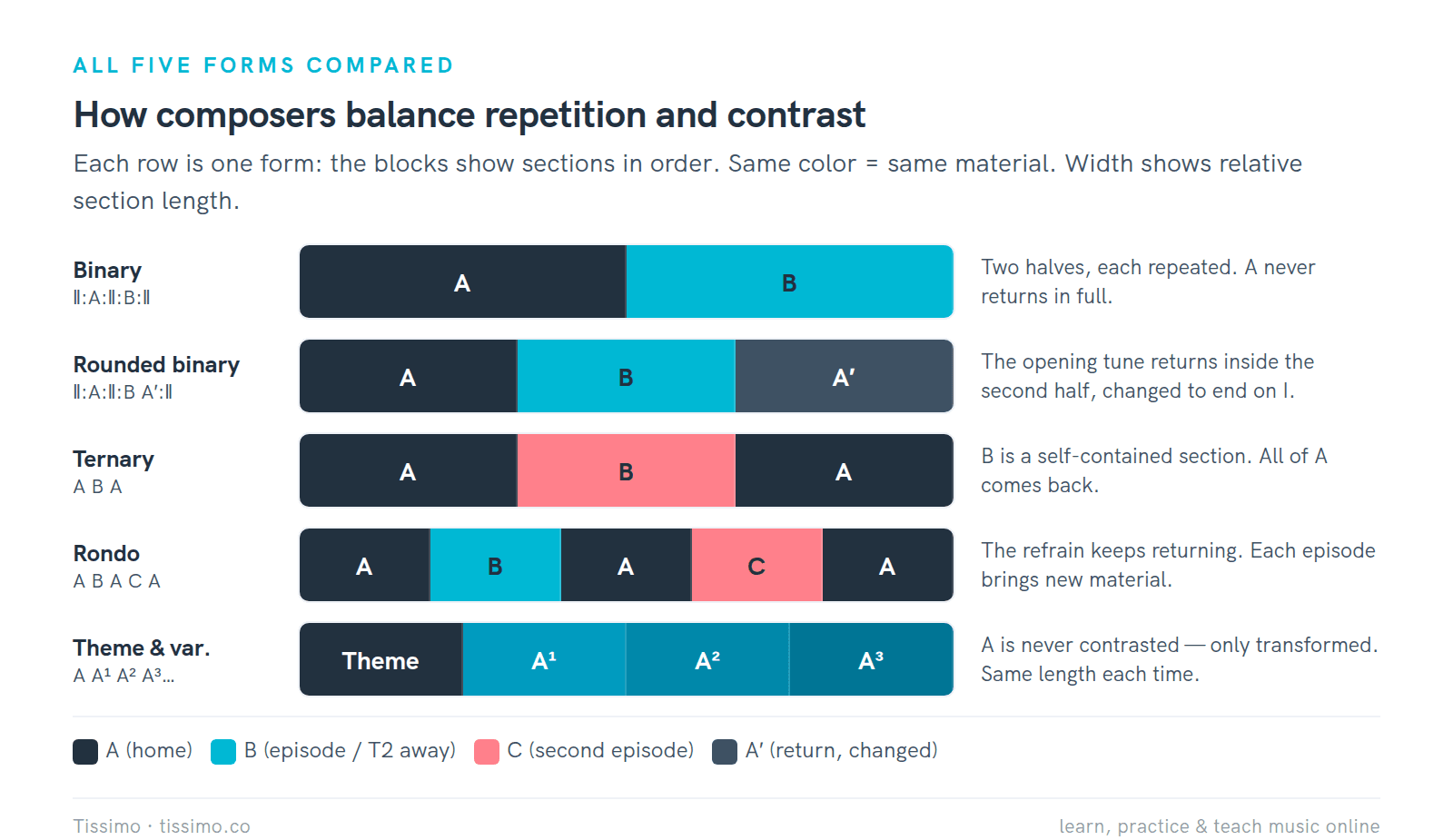
Five forms compared. The blocks show how often A returns and where contrast sits. Binary never fully restates A; rondo keeps coming back; sonata form makes Theme 2's return the climax.
A short original theme in two forms
Seeing the forms as blocks is useful; playing them is essential. The binary example below has A ending on the dominant G (a half cadence), and B closing on C (I). The rounded binary starts identically but adds an A′ that rewrites bars 7–8 to land on C.

Four original examples illustrating the forms. Each snippet is 4 bars or less; the letters above each section show how the blocks map to the forms discussed.
Play each half and stop at the last bar: in the binary you hear B closing on C without any sense of return; in the rounded binary A′ arrives and the opening feels like home.
A motif-to-sonata original example
One more piece ties all the threads together: a 16-bar original in C major that moves from a two-note motif through a sonata-form outline. The opening motif is a rising third, C–E. Bars 1–8 state it twice (antecedent ending on G, consequent ending on C) — that is Theme 1. Bars 9–12 sequence the motif up by step as a bridge, arriving on D (the dominant of G). Theme 2 begins in G major at bar 13 of the engraving, and bars 15–16 bring it home in C: the recapitulation in miniature.

An original 16-bar miniature in sonata-form outline: Theme 1 in C, bridge, Theme 2 in G (bar 13), recapitulation at home in C (bar 15). The two-note motif C–E is bracketed in bars 1 and 2.
This is the simplest possible sonata outline — no development, just exposition and recapitulation — but it makes the homecoming of Theme 2 audible in a piece short enough to play in 90 seconds.
Free worksheets for this lesson
- Musical form — the four-form overview (Handout 233) with listening examples and a variation exercise
- Binary, rounded binary & ternary — key-color maps, the decision-tree flowchart, and worked examples (Handout 354)
- Label the form — exercises on five pieces from Hot Cross Buns to Für Elise (Exercise 53)
- Sonata form — the three-part plan, Theme 2 excerpts from K. 545 and Clementi, and the three-question test (Handout 395)
- Sonata Detective: Which Theme Comes Home? — an audio exercise comparing the exposition and recapitulation in two sonatinas
- Motif and sequence — how short ideas are repeated, transposed, and varied (Handout 355)
- Phrase and period — antecedent and consequent phrases with an original example (Handout 232)
- Inside Beethoven's Für Elise — the rondo ABACA plan with bar numbers and practice recipe (Handout 342)
- Inside the Minuet in G — binary form in Petzold's Minuet, bar by bar (Handout 238)
- Inside the Sonatina in G — ternary vs. sonata form in a favorite sonatina (Handout 348)
- Inside Mozart's Sonata in C, K. 545 — the full sonata-form first movement (Handout 379)
- Inside Clementi's Sonatina in C — sonata form in a student's favorite (Handout 239)
Putting it into practice
Pick a piece you are already learning and open the score. Find the first place where something new begins — that is the end of A — and write an A above bar 1. Work through the listening steps above, writing letters at each section boundary. When you have a row of letters, name the form. Then check your answer against the worksheets for that piece, if one exists.
The letters do not make the music; they describe it. But describing a piece accurately lets you practice more efficiently — you know which section needs the most work, you understand why a passage feels the way it does, and you can hear a return before it arrives, the way a reader sees a paragraph break coming. A Tissimo teacher can sit with you and check your analysis in a live lesson, pointing out the passages where the form is genuinely ambiguous and explaining the conventions analysts use to decide.
Sources
- Open Music Theory, Chapter on Form — Kris Shaffer, Bryn Hughes & Brian Moseley (Viva Music Press)
- Inside the Minuet in G (Handout 238) — Tissimo
- Sonata form (Handout 395) — Tissimo
- Binary, rounded binary & ternary (Handout 354) — Tissimo
- Inside Beethoven's Für Elise (Handout 342) — Tissimo
- The New Grove Dictionary of Music and Musicians, 2nd ed.: "Binary form," "Rondo," "Sonata form" — Stanley Sadie & John Tyrrell, eds. (Oxford University Press, 2001)
- Music in the Western World: A History in Documents — Piero Weiss & Richard Taruskin (Schirmer Books, 1984)
Read this article online: https://tissimo.co/articles/musical-form-binary-ternary-rondo-and-sonata




Comments