 Back

Left-Hand Piano Accompaniment Patterns: From Block Chords to Alberti Bass
You know I, IV and V. You can play C, F and G7 with your left hand, and maybe you have used them to pick out a song. Then comes the next problem: playing the chord once per bar sounds like homework, and the right hand has nothing to lean on. The fix is not new chords. It is a pattern, a repeatable way of delivering the chords you already know. This article gives you six left-hand patterns in order of difficulty, all in C major over the same I–IV–V–I progression (with V as G or G7, depending on the pattern), so the only thing that changes from one example to the next is the pattern itself.
The six are block chords, broken chords, root-fifth, Alberti bass, waltz bass (oom-pah-pah) and an arpeggiated 1-5-8-10. For each you get what it sounds like, what style it fits, a four-bar example, and the mistakes that show up most often. Along the way you will see how to move between chords with the least possible motion in your fingers, and at the end there is a hands-separately-then-together practice recipe.

The six patterns in teaching order. The difficulty bars are our ranking for early students, not a standard one; if the waltz leap comes more easily to you than the Alberti speed, follow your own hands.
What a left-hand pattern does
The Tissimo worksheet Turn chords into grooves puts it plainly: a chord symbol tells you which notes to play, and a groove tells you when, and in what order. Same chords, different groove, different mood.
Two things are fixed for every example below. First, we stay in C major with C, F and G7 (the chords of The primary chords: I, IV & V). Second, the left hand reads the bass clef; the notes sit between low F (F2) and the E above middle C. If the bass staff still makes you hesitate, The Bass Clef & the Grand Staff is the quick refresher, and if you want the wider picture of coordinating both hands, see How to Play Piano With Both Hands.
Where a bar contains the F of G7, the chord symbol reads G7. Where it holds only G, B and D (or just G and D), it reads G. That is the honest label.
Pattern 1: block chords
Block chords are the chord played all at once. All three notes go down together, you hold for the bar, and you release. It is the sound of hymns and big final chords, and the Block & Broken Chords sheet describes it as "solid as a pillar". It is also the best place to learn the shapes, because nothing else is going on.

Pattern 1. Four whole-note chords: C (C-E-G), F (C-F-A), G7 (B-F-G), C again. Fingers 5-3-1 in the C chords, 5-2-1 in the other two.
Notice that the F chord is not F-A-C in the usual stacking: it is C-F-A, with the C on the bottom. The G7 chord is B-F-G. We will come back to why in the voice-leading section, because it is the most useful thing in this article.
Common mistakes: lifting the whole hand off the keys between chords (keep the fingers close to the surface), and pressing the notes at slightly different moments. Practice by listening for one clean sound, not three.
Voice leading: how to move without jumping
Voice leading is the way each note of one chord moves to a note of the next. Good voice leading, in the usual description, keeps each line smooth: it keeps common tones where it can, otherwise moves to the nearest chord tone, and avoids leaps. The Tissimo sheet Primary Chord Patterns teaches exactly this for our three chords: in the close shapes C-E-G, C-F-A and B-F-G, every change moves each finger one step or not at all. For the full story, see Voice Leading Explained.

The three close shapes. C to F: C stays, E goes up to F, G goes up to A. F to G7: F stays, C goes down to B, A goes down to G. G7 to C: G stays, B goes up to C, F goes down to E.
Compare that with stacking every chord in root position (C-E-G, F-A-C, G-B-D). The chords are correct, but your hand has to relocate for each one.

Top: every chord in root position (C, F, G, C), so the hand climbs and drops. Bottom: the close shapes (C, F, G7, C), so the hand barely moves. Same progression, but the close G7 adds the seventh (F) and drops the fifth (D).
There is an inversion story underneath this. C-F-A is an F chord with its fifth (C) in the bass, a second inversion, and B-F-G is a G7 with its third (B) in the bass and the fifth (D) left out. If those words are new, Triads & their inversions, Chord Inversions Explained and How to Build Piano Chords cover how triads and inversions are built. You do not need them to play the shapes; you only need to know that the shapes are not random.
Practice the changes silently first. Rest the hand on C-E-G, then morph to C-F-A and back without sounding anything, and feel which fingers move. The Primary Chord Patterns sheet suggests this drill.
Pattern 2: broken chords
A broken chord plays the same notes one after another instead of together. Any order counts, so up, down and zig-zag are all "broken". The simplest version for the left hand is bottom, middle, top, middle, one note per beat. It is the sound of lullabies and ballads, in the words of the worksheet, and it asks for almost nothing new: the same shapes, delivered one note at a time.
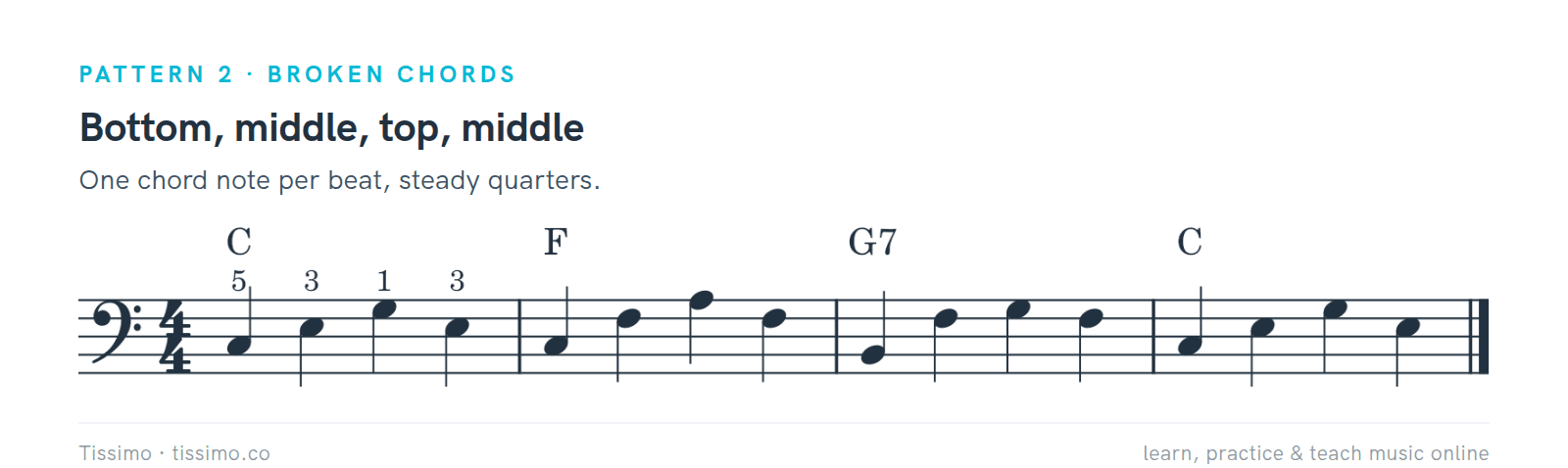
Pattern 2. Bottom, middle, top, middle on the close shapes. The thumb plays the top note, so the hand never leaves its position.
The main skill is evenness. Each note should have the same weight and the same length, so the pattern sounds like a gentle pulse rather than a stumble. Count 1-2-3-4 out loud and let the top note (beat 3) be no louder than the others. Block & Broken Chords has a nice listening test: play a song you know with blocked left-hand chords, then broken. Same song, same chords; the delivery is the style.
Pattern 3: root-fifth
Root-fifth uses only two notes of the chord: the root and the fifth. Play the root, then the fifth, then repeat. There is no third, so the sound is neither major nor minor; it is open and plain. That makes it a good foundation under a simple tune, and it is the first pattern where your hand has to jump rather than just reshape.

Pattern 3. Root, fifth, root, fifth. The C bars use C3 and G3, the F bar F2 and C3, the G bar G2 and D3. Fingers 5 and 1 in the first bar.
The chord symbol in the G bar is plain G: with only G and D there is no F, so no seventh. Each pair is a perfect fifth, five letter names counting both ends (C up to G, F up to C, G up to D). Your fingers have to land on both notes without a glance, so rehearse each pair with your eyes closed before you add the beat.
Common mistakes: looking down for every leap, and letting the fifth come out louder than the root.
Pattern 4: Alberti bass
Alberti bass takes the three notes of a chord and plays them in the order lowest, highest, middle, highest, over and over. In steady eighth notes it creates a flowing, sustained sound on the piano. It is named after Domenico Alberti, an Italian composer born around 1710 who used it extensively but was not the first to use it. It was often used in the Classical era. Mozart's Piano Sonata in C major, K. 545, which he entered in his own catalog on June 26, 1788 and described as a little piano sonata for beginners, opens with an Alberti bass under a singing melody.

Mozart, Sonata in C major K. 545, first movement, bars 1-2 (public domain), engraved by us; the pitches and rhythms were checked note by note against the Mutopia Project edition (typeset from the IMSLP score). That edition writes the left hand in treble clef; the pattern is the C-G-E-G you will play in Pattern 4, and in bar 2 the left hand spins D-G-F-G (a G7 shape) before returning to C-G-E-G.
The Alberti Bass sheet teaches the pattern with fingers 5-1-3-1 on C. Our version uses the same close shapes, so the order never changes: 5-1-3-1 on C, and 5-1-2-1 on F and G7, where the middle note takes finger 2 as in the block shapes.

Pattern 4. Alberti bass in eighths: in the C bar C3-G3-E3-G3 twice; in the F bar C3-A3-F3-A3; in the G7 bar B2-G3-F3-G3.
Play the left hand alone with your eyes closed, as the worksheet suggests; the pattern must live in the muscles. The most common problems are an accented top note (the thumb tends to dig in) and rushing. Think "quiet and even": the accompaniment should sound like a surface, not a series of events.
Then bring in a melody.
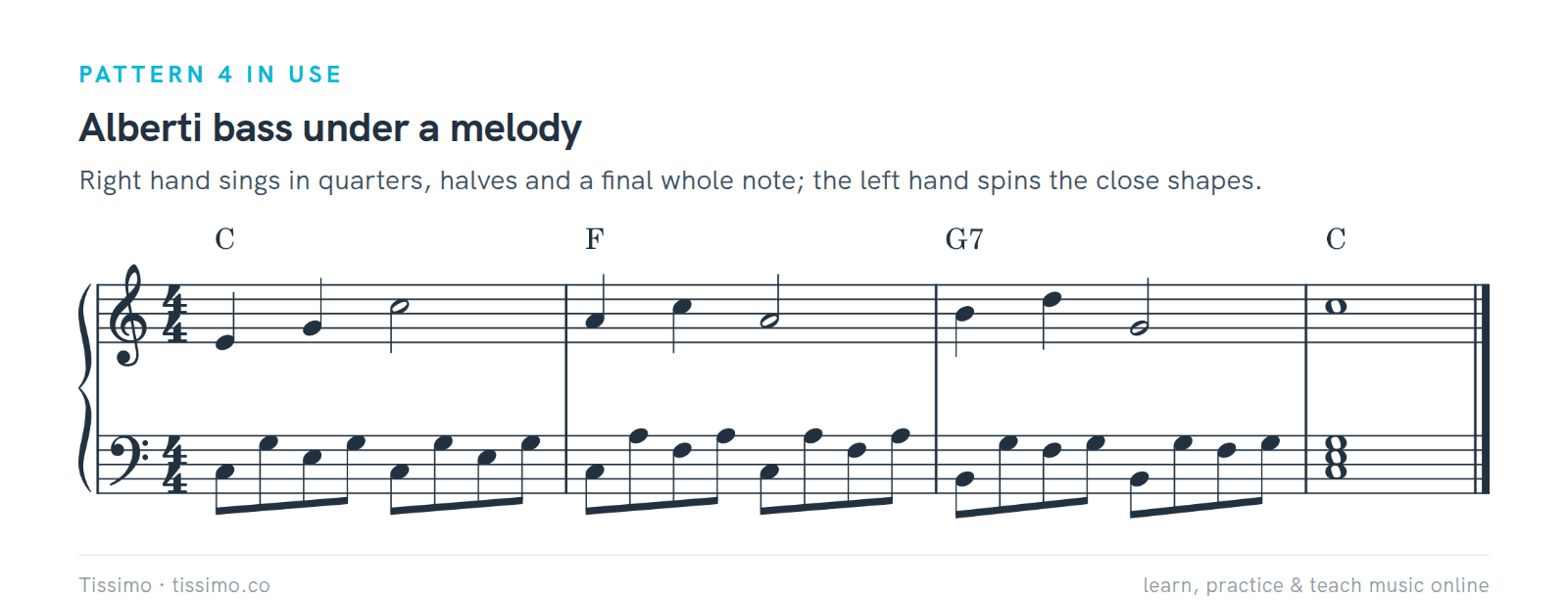
Pattern 4 under a short melody (our own). The right hand has quarter, half and whole notes; the left hand spins the close shapes. Bar 4 settles into a block C chord.
The balance is the whole art: a quiet, even left hand and a right hand that sings. If your left hand drowns the melody, play it softer, not slower.
Pattern 5: waltz bass (oom-pah-pah)
A waltz is dance music in triple meter, often written in 3/4. The accompaniment style associated with it plays the root of the chord on the first beat and the upper notes on beats two and three. That is the "oom-pah-pah": a low note that makes the first beat heavy, then two lighter chords.

Pattern 5. Each bar of 3/4: the root on beat 1, then the two notes above it on beats 2 and 3. G7 uses G2, then B2 and F3.
Unlike the close shapes, the waltz bass moves the hand to each chord's root, as Accompaniment patterns points out. So the preparation is a move of the whole hand to the next root (down a fifth to F, up a step to G, up a fourth back to C), and the thing to practice is landing it without looking. (The Tissimo sheets use "oom-pah-pah" for the close-shape version in Primary Chord Patterns and "waltz bass" for this root-based one; both are oom-pah-pah in the general sense.) Wikipedia's oom-pah entry describes the same idea from the band world: a bass sound alternating with higher off-beat chords, which in triple time becomes oom-pah-pah. The "pah" chords should be light: if they match the "oom" in weight, the waltz becomes a march.
This is the first pattern in a different meter, so count 1-2-3 out loud, with the "1" louder.
Pattern 6: arpeggiated 1-5-8-10
The last pattern is the widest. The numbers count up from the chord's root, like interval numbers: 1 (the root), 5 (the fifth), 8 (the octave) and 10 (the tenth, an octave above the third). An arpeggio is a chord whose notes sound individually in rising or falling order.

Pattern 6. Root, fifth, octave, tenth, then octave, fifth, third, fifth on the way back, in eighths. F and G bars use the same numbers counted from their own roots; the G bar has no F, so the symbol is plain G.
A tenth is a wide stretch for a small hand. If you cannot reach, play the "ballad" version first: 1-5-8-5, which the Accompaniment patterns sheet also gives for the left hand. For the final chord of its ballad, the worksheet offers the wider 1-5-10 (C-G-E) "if you can reach", and suggests adding pedal. The pedal is what lets the notes ring together while the hand travels. Take it slowly: the wrist travels with the hand, not against it.
We do not print a fingering for the tenth: the right one depends on the size of your hand, so let a teacher set it for you.
Common mistakes: accenting the tenth at the top of the reach, and holding the pedal through the chord change.
Choosing a pattern for a song
There is no rule that a style must use one pattern, but each pattern has a natural home.

A starting point for choosing. Try two patterns under the same song and keep the one that suits it.
A quick check: is the song in 3/4? Waltz bass is the natural first try. Is it slow and gentle? Try broken chords, or 1-5-8-10 with pedal. Is it a hymn, or does it end on a big final chord? Block chords. Does the piece sound Classical? Alberti bass is a classic fit. If none of that helps, root-fifth is the fallback: plain and clear.
When you have all six, the next step is a seventh pattern: stride, where the left hand plays a single bass note on beats one and three and a chord on beats two and four. The Accompaniment patterns sheet gives it a preview: look at the landing spot before you leap.
How to practice any pattern
Use the same recipe for all six. It is the hands-separately-then-together rule, in five steps.
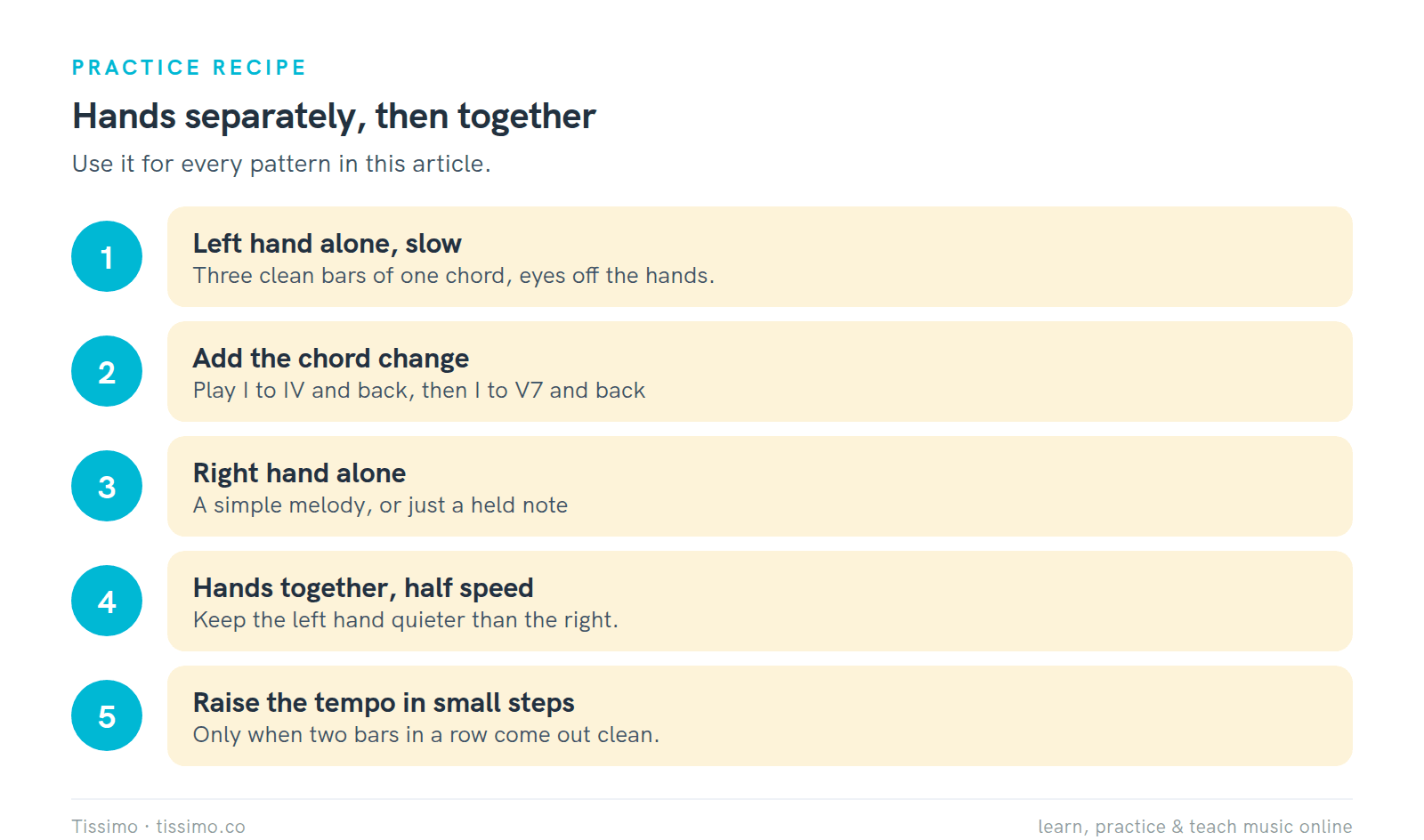
The recipe, one pattern at a time. Do not move to step 5 until two bars in a row come out clean at step 4.
- Left hand alone, slow. Three clean bars of one chord, eyes off the hands. Slow means slow enough that every note is even.
- Add the chord change. Play I to IV and back, then I to V7 and back, until the move is automatic.
- Right hand alone. A simple melody, or just a held note. The right hand is the part you hear, so learn what it does.
- Hands together at half speed. Keep the left hand quieter than the right.
- Raise the tempo in small steps. Only when two bars in a row come out clean.
If hands-together keeps breaking in the same bar, go back to step 2: the chord change is usually the trouble, not the pattern. The Turn chords into grooves sheet is a good test of whether you really know the patterns: you name eight grooves, then write the Alberti bass, waltz bass and ballad onto empty bars.
Ten minutes a day is a good start. Pick one pattern, run the recipe, and when you can play it with a melody, move on. The order in this article is a guide: if the pattern you need for your current song is number 5, learn that one first.
Free worksheets for this lesson
- Block & Broken Chords — one C chord, blocked and broken, and a listening test with a song you know
- Primary Chord Patterns — the close shapes for I, IV and V7 in 4/4 and 3/4, with voice leading
- Alberti Bass — the 5-1-3-1 pattern, with a melody on top and a history note
- Accompaniment patterns — waltz bass, ballad 1-5-8-5, steady-eighth pop and a stride preview, plus a pattern-picker table
- Turn chords into grooves — name eight grooves, then write your own
- Triads & their inversions — root position, first and second inversion
- The primary chords: I, IV & V — the three chords used in every example here
Where to go from here
A pattern is easy to learn and hard to hear in yourself. A Tissimo piano teacher can listen to your left hand in a live lesson and tell you whether the beat is even, whether the top note is sticking out, and whether the chord changes are clean. You can book a lesson when you want a second pair of ears.
Sources
- Alberti bass — Wikipedia
- Domenico Alberti — Wikipedia
- Piano Sonata No. 16 (Mozart) — Wikipedia
- Piano Sonata No.16 in C major, K.545 — IMSLP
- Voice leading — Wikipedia
- Waltz (music) — Wikipedia
- Oom-pah — Wikipedia
- Arpeggio — Wikipedia
- Stride piano — Wikipedia
- Sonata Facile, first movement (K. 545) — Mutopia Project edition, CC BY-SA 3.0, source IMSLP (used only to check the pitches and rhythms of our own engraving of bars 1-2 in Pattern 4)
- Block & Broken Chords — Tissimo worksheet (hymns and grand endings vs. lullabies and ballads)
- Accompaniment patterns — Tissimo worksheet (waltz bass, ballad, stride preview, pattern-picker table)
Read this article online: https://tissimo.co/articles/left-hand-piano-accompaniment-patterns-for-beginners




Comments