 Back

Violin Bow Distribution: How to Plan Enough Bow for the Long Note
A long note is coming, but you are already near the end of your comfortable bow region. Before playing, check your starting point, direction, and how much bow the earlier notes use. In this lesson’s model, keep a steady quarter-note pulse and a constant bow speed: each quarter note uses ¼ of a teacher-chosen region, so a half note uses ½. This is a practice model, not a rule for every musical phrase.
Bow length is a resource

The frog and tip are fixed parts of the bow. Down-bow (⊓): the string’s contact position moves along the hair toward the tip. Up-bow (V): it moves toward the frog. The arrows track contact position, not one bow end moving toward the other.
Your teacher chooses a comfortable section of the bow hair for this task. Treat that region as a number line from 0 to 1: the frogward boundary of the region (0) and the tipward boundary (1). These boundaries need not be the physical frog and tip. Keep each planned stroke within them. Use open D first, with your teacher-set hold; add A separately before practicing a string change.
Keep two kinds of location separate when reading the figures. Position ½ means halfway along your chosen section of hair. It does not tell you where to place the bow between the bridge and fingerboard. Ask your teacher to identify both on your instrument before comparing your movement with the diagrams. The arithmetic tracks only the first location.
The bow is a resource in the same sense that time is. A four-beat bar gives you exactly four beats to spend; your usable bow region gives you exactly 1 unit of travel to spend per pass. Once you understand that, distributing the bow becomes arithmetic.
If two consecutive down-bows use ½ and then ¾ of the region from 0, their endpoints are ½ and 1¼. The second endpoint lies outside the chosen region. Calculate that failure on paper; do not try to play beyond the boundary. A valid number plan is the first check; sound and comfortable movement still need your teacher’s attention.
Teacher chooses a comfortable usable region

The full 0–1 strip represents your teacher-chosen region, which may occupy only part of the bow. Its quarter divisions mark one quarter-note beat’s travel in this model. These positions run along the hair; they are not distances from the bridge.
Ask your teacher to identify the two boundaries on your bow and a comfortable starting point between them. Point out where the hair meets the string before playing: that location along the hair is the position you will compare with the diagram. Keep the same chosen region while checking a cell, so the fractions retain their meaning.
The full strip represents that chosen region. There are no centimeter targets, required whole bows, or prescribed force settings here.
Bow speed controls travel per second. Bow force and the contact point between bridge and fingerboard also affect the sound, so your teacher balances all three. For the arithmetic below, keep the pulse, string, and intended sound steady. Simon Fischer’s Bow Speed explains these coordinated controls.

Down-bow adds to position; up-bow subtracts. A full down-bow runs 0 → 1 and a full up-bow 1 → 0 — a whole note at this rate. A half note moves half as far: from ½ a down-bow half note ends at 1. Both rows keep the same axis: 0 on the left and 1 on the right.
The direction matters as much as the distance. On a down-bow, the string’s contact position moves along the hair toward the tip, so the number increases. On an up-bow it moves toward the frog, so the number decreases. From ¼, a down-bow quarter reaches ½; an up-bow half then reaches 0. That is the region’s frogward boundary, not necessarily the physical frog.
Equal durations in equal regions as a starting model
Begin with four separate quarter-note pulses in one down-bow. Your teacher demonstrates stopping and restarting without reversing. This isolated drill spends the region in four equal parts; it is not an instruction to keep playing down-bows after reaching 1. Reset before repeating.

Four quarter-note pulses use ¼ each: 0 → ¼ → ½ → ¾ → 1. The numbered tracks follow the notes in order. These separate pulses share one down-bow; your teacher demonstrates brief stops without reversing. Stop at 1 and reset before repeating this isolated drill.
This is the starting model: one beat equals ¼ of the usable region. A quarter note (1 beat) uses ¼. A half note (2 beats) uses ½. A dotted half note (3 beats) uses ¾. A whole note (4 beats) uses the entire region for one note.
One note can occupy its own bow stroke, or several notes can share a bow. Count the whole group before choosing its start. The bow-direction mark belongs to a stroke; a new printed note does not automatically mean that the bow must reverse. Ties vs Slurs teaches the general notation distinction using keyboard examples. On violin, a bowing slur normally groups notes into one bow; budget the total duration of that group. A tie adds durations into one sound and does not itself specify a change of bow.
For example, a quarter and half under one bowing slur total three quarter-note beats. At this exercise’s rate, their shared stroke needs ¾ of the region. Starting at ¼ on a down-bow would reach 1; starting at ½ would reach 1¼ and fail. Treat the group as one continuous budget even though two noteheads are printed. These calculations explain the violin application; the linked keyboard sheet teaches the notation distinction.
Read the next three examples in 4/4, with the quarter note as one beat. The remaining beats are rests. Budget the sounded note only, then hold position through the rests in these isolated comparisons.

At constant speed in this model, the D4 quarter lasts one quarter-note beat and uses ¼ of the region, starting at 0. The three quarter rests complete the 4/4 bar. Hold at the dot on the rest row, position ¼, through those remaining counts.
Count the quarter’s onset on 1, then count 2, 3, and 4 without continuing the stroke. Now compare the half note: its sound lasts through beat 2 before the rest begins.

At constant speed in this model, the D4 half note lasts two quarter-note beats and uses ½ of the region, starting at 0. Hold there through the half rest. Compared with the quarter-note example, doubling the sounded duration doubles the distance traveled.
The dotted half continues through beat 3. Its dot adds half of the undotted half note’s value: two beats plus one beat. Keep the pulse steady as the duration grows.

At constant speed in this model, the D4 dotted half lasts three quarter-note beats and travels from 0 to ¾. Hold at ¾ during the quarter rest on beat 4. The dot changes duration; the bow mark still specifies down-bow.
At the same bow speed, a half note travels twice as far as a quarter, and a dotted half travels three times as far. Giving them equal travel instead requires different speeds; that may be intentional in real music, but it is outside this constant-speed exercise.
Long/short notes need a plan

The planning model in 4/4: quarter-note beats multiplied by ¼ give the travel fraction. Percentages refer to the teacher-chosen region, not the entire bow. The whole-note row describes a down-bow from 0 to 1, or an up-bow from 1 to 0; another start needs a revised allocation. The fraction column is distance for one sounded duration. A route still needs a starting point and a direction before these distances can become endpoints.
A dotted half uses ¾ of the region under this model. From 0, a down-bow reaches ¾. Before the following note, decide what happens during its written rest: hold position, prepare a string change, or make a teacher-demonstrated reset. These are different actions. A rest supplies time, but does not automatically change the starting position.

Start at ¼. Quarter down: ¼ → ½; half up: ½ → 0; rest without moving. Half down: 0 → ½; quarter up: ½ → ¼; rest without moving. Every endpoint stays within the region. Each quarter rest completes its 4/4 bar; neither rest resets the bow for this calculation. The complete cycle ends at its initial ¼. Check the two stationary rest rows separately from the sounding arrows; they complete the meter without changing position.
Alternating bows often helps reuse a region, but follow the written bowing. Some patterns have consecutive notes in the same direction; your teacher can show you how to stop and restart without reversing. For any pattern, calculate the endpoints rather than assuming alternation will balance it.
The mixed route needs its stated starting point. Starting the same marks at 0 would make the first half-note up-bow end at −¼. From ¼ it fits and returns to ¼. Check the start as well as the directions before repeating; an alternating pattern can still fail when its distances are unequal.
Try a prediction before reading the mixed-route caption again: would a start at ½ also fit? Its endpoints would be ¾, ¼, ¾, and ½, so it fits too. The printed start at ¼ is one valid choice, not the only one. Starting at 1 would fail on the first quarter down. Locate the first invalid endpoint rather than rejecting a whole route without explaining where it fails.
Predict the next bow direction and starting point
The real skill in bow distribution is looking ahead. Before you play note 2, you know where note 1 ends, and that endpoint is note 2's starting point. Before you play note 3, you know where note 2 ends. The whole phrase is a chain of positions, and each link is just addition or subtraction.
Here is a phrase that runs out:

Keep the bow at ¾ through the first written rest. The next down-bow would need another ¾, ending at 1½. This plan fails unless you reset during that rest or change the next bow direction. The coral extension is a paper prediction beyond the tipward boundary, not a stroke to attempt on the instrument. The extended axis is identical to the reset variant below. Its extra space displays the error; it does not enlarge the teacher-chosen region.
The first endpoint is 0 + ¾ = ¾. Keeping that position during the rest means the next endpoint would be ¾ + ¾ = 1½. Only ¼ remains before boundary 1, so the second note’s planned ¾ cannot fit. Stop the paper calculation there rather than trying to force the stroke.
Use the existing rest for a teacher-demonstrated reset to 0, or change the second note to up-bow and leave the bow at ¾ during the rest. The changed-direction version is Handout 424 Route C: 0 → ¾ → 0. Both strokes fit, and the bow returns to its starting position.
The next figure keeps both down-bow marks and both written quarter rests. It changes only what happens during the first rest. This is an original reset variant; it is not the handout’s Route C.

Start at 0; the first dotted half reaches ¾. During the written rest, lift and reset to 0 with your teacher’s guidance. The next down-bow reaches ¾ again. Without that reset, it would reach 1½. The dashed arrow is a silent lifted reset during the existing rest; the solid arrows are sounding strokes. The first and second sounded arrows have equal length and direction. The change from the failed plan is confined to the intervening rest, not the music’s duration.
A rest may be a pause with the bow still, a time to prepare a new string, or time for a silent reset. For a reset, ask your teacher to demonstrate lifting the hair clear of the string, moving to the planned starting position, and settling before the next note. Choose that position from the next note’s direction and distance. The rest keeps its written duration while you prepare the next stroke.
Compare the reset variant with Route C before playing either. Both begin with a down-bow to ¾ and contain the same first quarter rest. In Route C, stay at ¾ because the next note goes up. In the reset variant, return to 0 because the next note goes down. The rest symbol alone cannot tell you which action is intended; the next direction and the stated plan settle that question.
The Bow Budget handout shows four two-bar routes. Its printed rule keeps position during every rest. Route B fails under that rule; Route C reverses after its first rest and fits. Calculate all four before playing the valid routes. The reset variant above deliberately changes the rest action, so it is a separate comparison.
Play original open-string cells
After planning on paper, check the route on your instrument. Start on open D so you can attend to the bow without adding left-hand notes or a string crossing. The next route follows the handout’s printed marks exactly.

Route D from Handout 424: half down (0 → ½), quarter up (½ → ¼), quarter down (¼ → ½), half up (½ → 0), half down (0 → ½). All positions stay within the region; the route ends at ½, so reset to 0 before repeating from the original start. The numbered tracks follow the five printed notes in order. The half-note strokes each travel ½ and the quarter-note strokes ¼. The final ½ is a valid endpoint, but differs from the original start at 0.
Route D alternates directions, but its unequal durations leave it at ½. Before repeating, notice that a second run starting there would have different endpoints. Check each new start instead of assuming a complete bar resets the bow. For this isolated drill, stop and reset to 0 before repeating; that checking pause is not part of the written two-bar rhythm.
First pause after each note and check the planned position. Then play the same cell in the written rhythm.
With your teacher’s chosen starting point, play the cell on D while watching the hair’s position at the string. Check the actual endpoint after each note against your plan. Repeat in time without the checking pauses; listen for an even sound through the long note. If the endpoint differs, change the amount of travel before repeating. Try A separately after D feels secure.
With practice, you can recognize the positions without saying every number aloud.
The Bow Plan Check exercise gives you six endpoint problems to solve on paper in Section 1, then four "repair" problems in Section 2 where you choose between two options for fixing a route that runs out. Section 3 has two short play routes — Route X and Route Y — to perform on open strings after the written work.
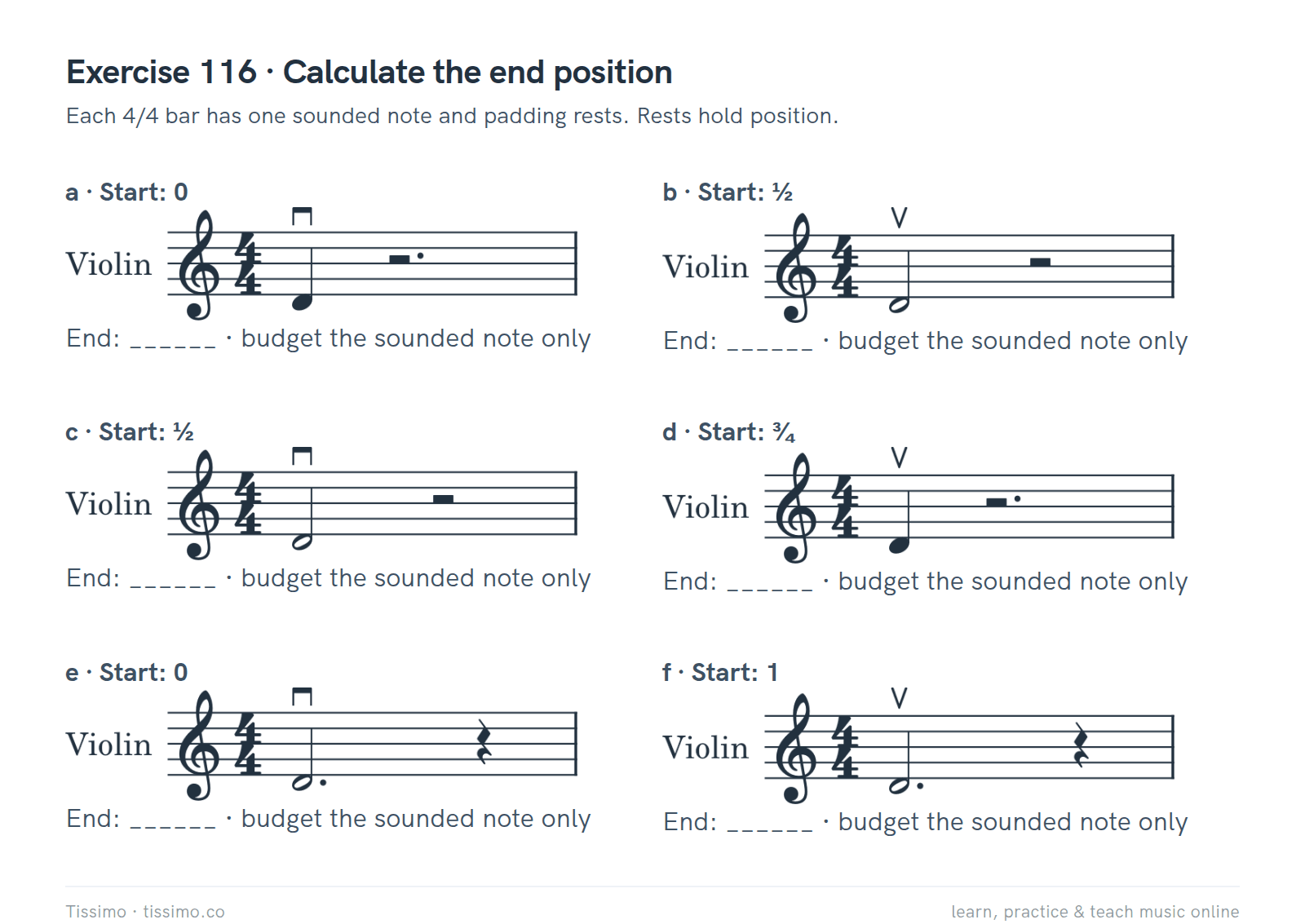
Six endpoint problems from Exercise 116, Section 1. Budget only the sounded note at ¼ per quarter-note beat; the padding rests complete each 4/4 bar and hold position. Down-bow adds, up-bow subtracts. Starting values match the worksheet. Fill in each endpoint before consulting its upside-down answer key; the note’s bow mark supplies the sign of the calculation. Read the given start rather than carrying an answer into the next letter: these are six independent questions, not six consecutive strokes.
Item a asks for a quarter-note down-bow starting at 0: 0 + ¼ = ¼. Item b starts at ½ and subtracts ½, ending at 0. Item e starts at 0 and adds ¾, ending at ¾. An endpoint exactly at 0 or 1 is inside the region; below 0 or above 1 is outside.
For Section 2, keep the note lengths and bow directions printed in each question. Read both offered repairs before choosing. In P1, holding at ¾ leaves insufficient room for another dotted-half down-bow; resetting to 0 gives that note room. In P2, a half-note up-bow needs ½ of travel: starting at ¼ fails, while starting at ¾ reaches ¼. Explain the rejected option as well as the chosen one; a different start can repair a route without any reset.
After completing the paper exercises, the play routes put the plan into practice:

Route Y: start at 0, play D down to ¾, pause at ¾ through the quarter rest while preparing A, then play A up to 0. Change strings during the rest. Both bars keep their full four quarter-note beats. The string change prepares a new string without resetting the position along the bow hair. The stationary rest row is deliberate: lifting and resetting to 0 would remove the room needed for the following three-beat up-bow.
For this first string-change drill, prepare the new string during the written rest. Follow the marked direction on the next note.
Count Route Y aloud: D sounds on 1 and continues through 2–3; beat 4 is silent while you prepare A and keep position ¾. A sounds on the next 1 and continues through 2–3; the final beat is silent at 0. First ask the teacher to observe the position during the string change. Then check the whole route in time, including both complete rests.
Adjust for sound rather than treating fractions as a law
Keep two down-bow dotted halves, starting at 0, with the bow still during the intervening written rest. At ¼ per quarter beat the endpoints are ¾ and 1½: too far. For a paper comparison, try ⅛ per quarter beat instead. The endpoints become ⅜ and ¾, so the route fits without changing the rhythm or bow marks. Ask your teacher whether that slower speed gives the sound you want.

The rhythm, down-bow marks, starting point, and rest action remain identical. Only travel per quarter-note beat changes. At ¼, each three-beat note travels ¾; at ⅛, it travels ⅜. Both panels use the same extended axis so the coral overrun can be compared directly with the slower plan. This changes the exercise’s travel rate; it does not prescribe a universal speed. Read the stationary rest row in each panel before comparing the second note. Neither version uses a lifted reset or an extra rest to make its calculation work.
The second calculation is a different model. It saves bow without adding time or changing the printed marks. Fischer’s Using Less Bow discusses musical contexts for saving travel; the teacher checks whether a slower stroke suits this beginner cell.
For a note of the same duration, increasing bow speed can help increase volume, but your teacher balances speed with bow force and contact point. A loud note does not automatically require more total bow than a quiet one.
Even within a small region, listen for changes in sound; your teacher may adjust how you use the bow.
The four-step routine puts the model in its proper place:
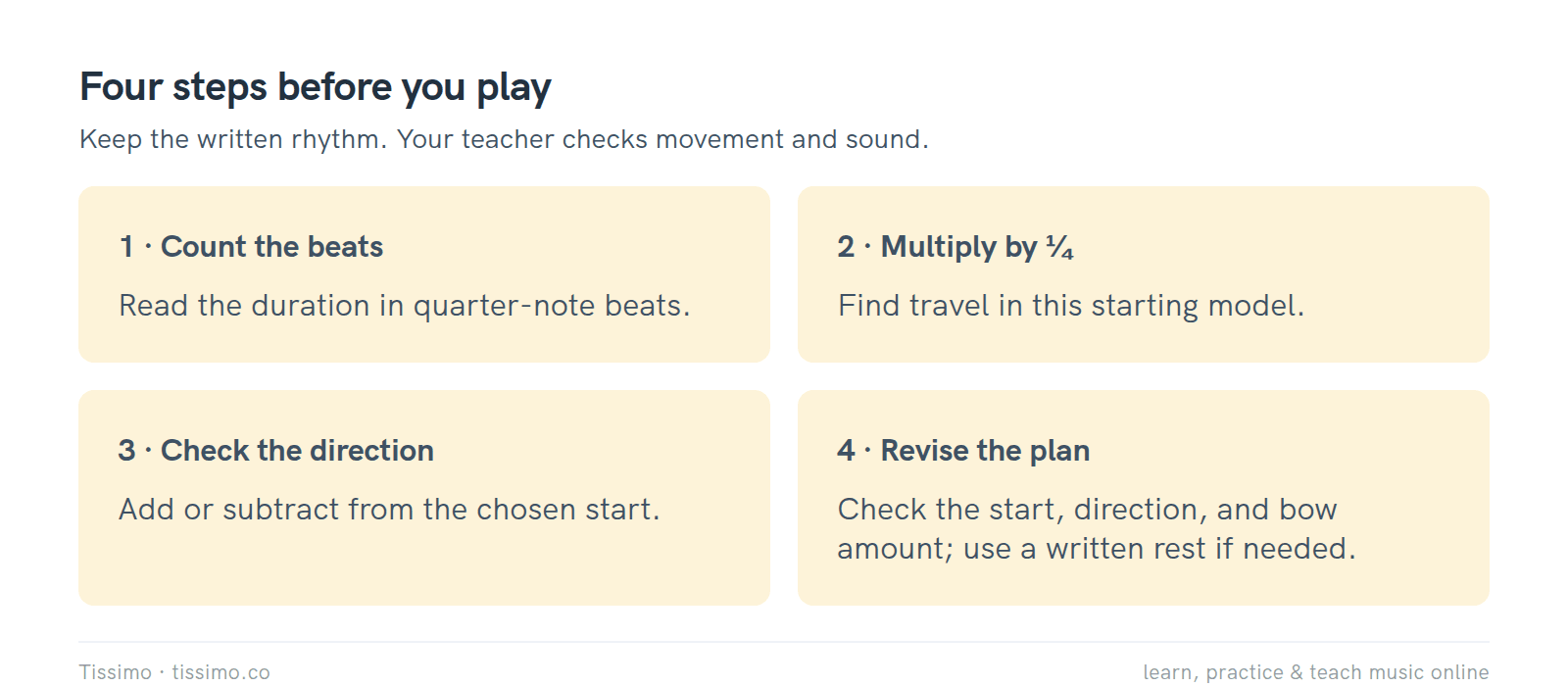
The four-step plan scopes ¼ to this starting model. Count quarter-note beats, multiply for distance, then add or subtract from the chosen start. Revise a failing route with your teacher. A written rest can hold position, prepare a string, or permit a specified lifted reset; it does not automatically return the bow to 0. Use the final card when the arithmetic fails or the sound needs adjustment. Recheck the full chain of endpoints after changing any earlier stroke.
If an endpoint falls outside 0–1, ask your teacher whether to change the starting point, bowing, or travel per beat. Use an existing rest for a reset where appropriate. Do not insert extra beats into the written music.
Take as long as you need to check each endpoint. As the music changes, adapt the bow plan to its rhythm and sound.
The free worksheets for this topic
These sheets connect directly to the concepts in this article:
- Plan Your Bow: Long and Short — Handout 424. Three sections: the normalized bow strip, note-value cells with bow marks, and four two-bar routes. Work out which route runs out before you play.
- Will There Be Enough Bow? — Exercise 116. Six endpoint computation boxes, four repair problems, and two short play routes on open D and A strings.
- Notes 2: The Half Note — Half notes, stems, and the two-beat duration rule with practice bars.
- Notes 4: The Dotted Half Note — How the dot adds half the note's value, making a dotted half worth three beats.
- Ties vs Slurs — distinguish tied notes, whose durations add into one sound, from slurred notes played smoothly.
Keep the teacher in the loop
Bring a specific observation to your lesson: which note missed its planned endpoint, whether the sound changed, and what happened during the rest. Separate those checks. A clean sound alone does not show that the bow stayed within the chosen region.
Use three separate checks for a repeat: each observed endpoint agrees with the plan, each note and rest keeps its written duration, and the long note sustains an even sound. If only the first check fails, compare travel amounts. If counting breaks down, rehearse the rhythm separately. If the numbers fit but the tone changes, ask the teacher to examine the coordinated bow controls rather than changing fractions at random.
A violin teacher on Tissimo can compare the plan with your actual movement and sound, demonstrate a reset, and help choose a useful adjustment for the next attempt.
Sources
- Bow Distribution Curriculum — Red Desert Violin — Public course outline describing bow proportions, rhythmic values, and planning.
- Bow Speed — Simon Fischer — coordinated speed, force, and soundpoint.
- Proportions — Simon Fischer — changing the relationships between technical controls.
- Using Less Bow — Simon Fischer — context-sensitive choices for saving bow.
- Retakes — Simon Fischer — distinguishes saving bow from retaking; advanced examples are not beginner prescriptions.
- Bowing — Yamaha — basic bow alignment and relaxed movement.
- The structure of the bow — Yamaha — bow hair and rosin.
- What do you call the part on the bow that you hold? — Yamaha — identifies the frog.
- Contemporary and historical performance practice in late eighteenth-century violin repertoire — Jun He — section 2.1 distinguishes bowing slurs from broader phrase meanings.
Read this article online: https://tissimo.co/articles/violin-bow-distribution-long-short-notes




Comments