 Back

Transposing Instruments Explained: Concert Pitch, B♭/E♭/F Instruments, and How to Read for Them
Pick up a B♭ trumpet part and a piano part for the same piece of music. Place them side by side. The trumpet is reading in D major, two sharps on the staff. The piano is reading in C major, no sharps at all. Both players are performing the same concert pitch. Neither part is wrong — the trumpet's part is simply written a major 2nd higher than what it sounds, because the trumpet is a transposing instrument.
This guide explains what that means, why instruments are built that way, and how to work out the written key for any transposing instrument starting from concert pitch.
Concert pitch: the shared reference
Concert pitch is the actual sounding pitch — the pitch you hear in the room, independent of which instrument is playing it. When every instrument in an ensemble plays concert A4, every player hears 440 Hz regardless of what note is written on their own staff.
A C instrument (also called a concert-pitch instrument) is one whose written pitch and sounding pitch are the same. The piano, flute, oboe, violin, and cello are all C instruments: when a pianist reads middle C (C4), it sounds at concert C4. The guitar and double bass are also C instruments, though they sound an octave lower than written — a quirk covered below.
A transposing instrument is one whose written note sounds at a different concert pitch. When a B♭ trumpet player reads C4, the note that comes out is concert B♭3 — a major 2nd lower. The instrument is named after the concert pitch that its written C sounds: a B♭ instrument sounds B♭ when the player reads C; an E♭ instrument sounds E♭; an F instrument sounds F.

The three main transposing families. A B♭ instrument sounds B♭ when the player reads C; an E♭ instrument sounds E♭; an F instrument sounds F. C instruments are shown for comparison.
Why transposing instruments exist
The historical reason is mechanical: each instrument in a family was originally built in a fixed key determined by the physics of its tube length. A clarinet in B♭ has a tube long enough that its natural resonance centers on B♭. Early players learned one set of fingerings for their instrument. When composers started writing for the full clarinet family (B♭, A, E♭ and others), they made each part transposing so that a player who already knew the B♭ clarinet could pick up an A clarinet and use the same fingerings — the music simply sounded at a different pitch.
The same principle applies to the saxophone family (all invented by Adolphe Sax in the 1840s), the horn family, and the brass family. Within each family, identical fingering produces different concert pitches depending on the instrument's size, but the relationship between written note and fingering stays constant.
A secondary benefit is range legibility. Instrument parts are written to keep most notes on the staff, without excessive ledger lines. The tenor saxophone, for example, sounds much lower than a flute; writing it at concert pitch would push most of its range into ledger lines below the staff. Writing it in a higher key (a major 9th above concert pitch) brings the notes comfortably onto the treble staff.

Two reasons transposing instruments exist. Fingering consistency is the original reason; staff legibility is the practical result.
The B♭ family: a major 2nd lower than written
The B♭ family includes the B♭ trumpet, B♭ clarinet, B♭ soprano saxophone, and B♭ tenor saxophone. These instruments sound a major 2nd lower than written. When the player reads a C, the audience hears a B♭ — one whole step down.
The rule for writing: to make a B♭ instrument sound a given concert pitch, write a major 2nd higher.
If the ensemble is playing in concert C major, the B♭ trumpet and B♭ clarinet parts are written in D major — up a major 2nd, which adds two sharps (F♯ and C♯).

C major at concert pitch (top). Written for a B♭ instrument (bottom): D major, two sharps. The player reads D; the audience hears C.
The tenor saxophone is also a B♭ instrument, but it sounds a major 9th lower than written (an octave plus a major 2nd). Its parts are still written in D major for a concert-C piece, but the notes sit an octave higher on the staff compared to a B♭ clarinet playing the same concert passage, so the written range lands in a playable register on the larger instrument.
The soprano saxophone is a B♭ instrument that sounds exactly like the B♭ clarinet — a major 2nd lower than written.
The E♭ family: a major 6th lower than written
The E♭ family includes the E♭ alto saxophone and the E♭ baritone saxophone. These instruments sound a major 6th lower than written. When an alto saxophone player reads C4, the audience hears concert E♭3 — nine half steps (a major 6th) below.
The rule for writing: to make an E♭ instrument sound a given concert pitch, write a major 6th higher.
For a concert-C major piece, the alto saxophone part is written in A major — up a major 6th, which uses three sharps (F♯, C♯, G♯).
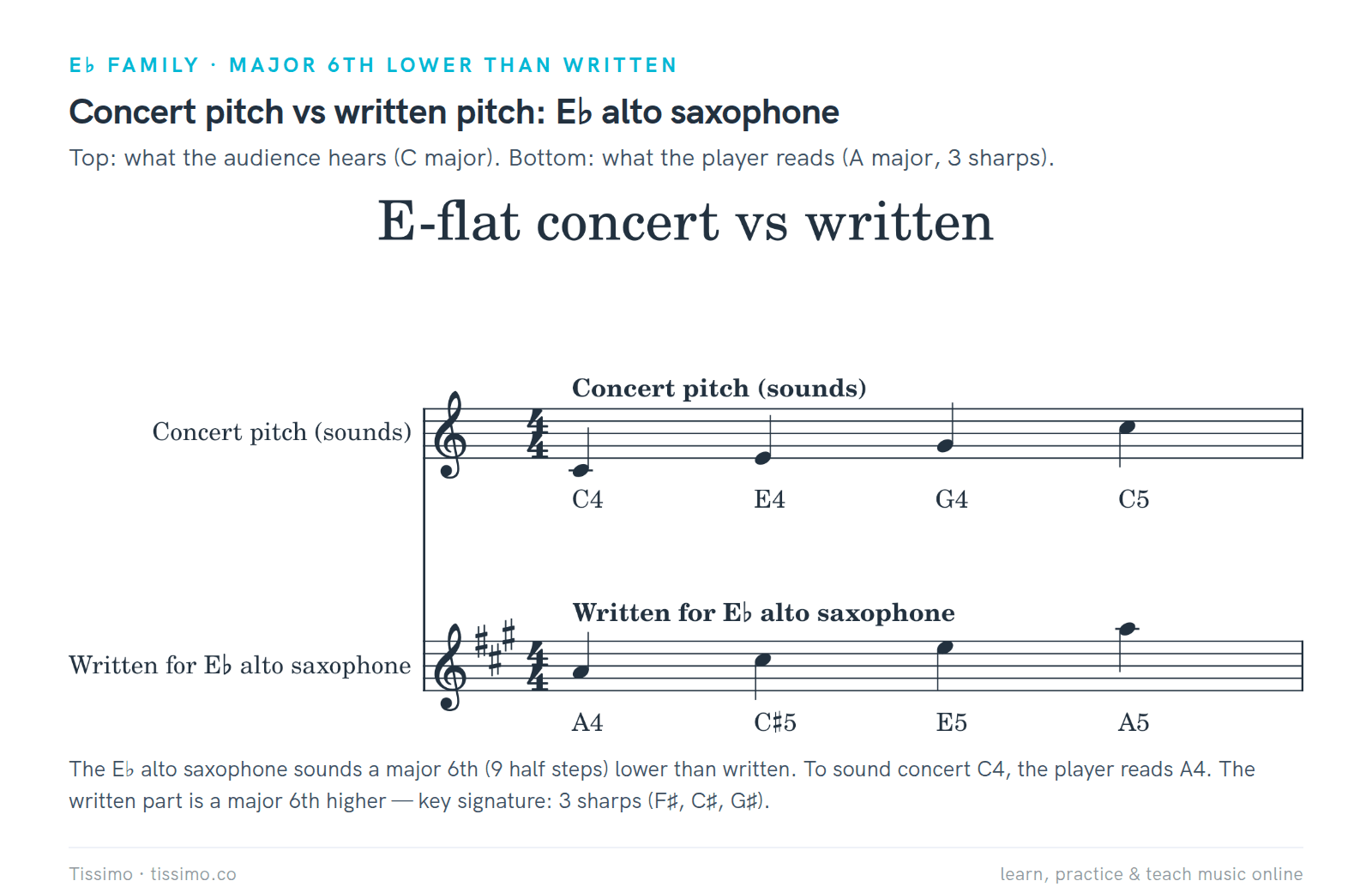
C major at concert pitch (top). Written for E♭ alto saxophone (bottom): A major, three sharps. The player reads A4 to sound concert C4.
The baritone saxophone is also an E♭ instrument, but sounds an octave lower than the alto — a major 13th (octave plus major 6th) below written. Its parts still use the A major key signature for a concert-C piece; the written notes simply occupy a lower range on the staff.
The F family: a perfect 5th lower than written
The F family includes the French horn in F and the English horn (cor anglais). These instruments sound a perfect 5th lower than written. When a French horn player reads C4, the audience hears concert F3 — seven half steps (a perfect 5th) below.
The rule for writing: to make an F instrument sound a given concert pitch, write a perfect 5th higher.
For a concert-C major piece, the French horn part is written in G major — up a perfect 5th, which uses one sharp (F♯).

C major at concert pitch (top). Written for French horn in F (bottom): G major, one sharp. The player reads G4 to sound concert C4.
The English horn is a transposing oboe in F, used in orchestral music. It uses the same transposition interval as the French horn — a perfect 5th — so its parts are also written in G major for a concert-C piece.
The worked example: concert C major
This table shows the written key and key signature each instrument uses when the ensemble is playing in concert C major:

All six transposing instruments for a concert-C piece. The key signature column is what appears at the start of each instrument's staff. Baritone sax and tenor sax share the key signature of their family (3 sharps and 2 sharps respectively) but play in a lower octave.
The interval from concert C to each written note can be verified by half-step count:

Concert C4 and its written equivalent for each transposing family. M2 up (2 half steps) = D; P5 up (7 half steps) = G; M6 up (9 half steps) = A. Verify by counting half steps: C→D = 2 ✓, C→G = 7 ✓, C→A = 9 ✓.
Verify every entry against the interval rules:
- B♭ trumpet: concert C + M2 up = D (D major = 2 sharps) ✓
- B♭ clarinet: concert C + M2 up = D (D major = 2 sharps) ✓
- French horn in F: concert C + P5 up = G (G major = 1 sharp) ✓
- Alto saxophone: concert C + M6 up = A (A major = 3 sharps) ✓
How to work out the written pitch from concert pitch
The process has two steps: find the interval, then apply it.
Step 1: Identify the instrument's family. B♭ → major 2nd up. E♭ → major 6th up. F → perfect 5th up.
Step 2: Apply the interval to the concert-pitch note. Count letter names first (C up a 2nd lands on D; C up a 6th lands on A; C up a 5th lands on G), then verify with half steps (M2 = 2 half steps; M6 = 9 half steps; P5 = 7 half steps).
Step 3: Use the key of the destination note. D major → 2 sharps. A major → 3 sharps. G major → 1 sharp.

Three steps from concert key to written key. The same logic applies to individual notes: apply the interval to every note, then trust the written key signature for the accidentals.
The same method works for individual notes, not just for key signatures. If the concert pitch has a solo melody note of E♭4 and you are writing for a B♭ clarinet, move E♭ up a major 2nd: E♭ + M2 = F4. The clarinet reads F4 and sounds concert E♭4.
How to work out concert pitch from written pitch
Going the other direction — reading a transposing part and finding the concert pitch — is the reverse:
- B♭ instrument: subtract a major 2nd (move down a major 2nd from the written note).
- E♭ instrument: subtract a major 6th (move down a major 6th from the written note).
- F instrument: subtract a perfect 5th (move down a perfect 5th from the written note).
If a French horn part has a written G, the concert pitch is G minus a P5 = C. If an alto saxophone part has a written A, the concert pitch is A minus a M6 = C.

Reading a B♭ clarinet part: subtract a major 2nd from each written note to find concert pitch. Written D major sounds as C major at concert pitch.
The Written & concert pitch worksheet works through all three common instruments in both directions: written-to-concert and concert-to-written, with exercises and an answer key.
Octave-transposing instruments
A few instruments are written at a different octave from concert pitch, without changing the key. These are octave transposers:
- Piccolo: sounds an octave higher than written. A piccolo player reads the same note names and key signatures as a flute, but every note comes out an octave up.
- Double bass: sounds an octave lower than written. The double bass is notated on the bass staff at face value but sounds one octave lower than written.
- Guitar: sounds an octave lower than written, like the double bass. Guitar parts are written in treble clef at concert pitch but the instrument sounds an octave below.
Octave transposers are sometimes called "non-transposing" because they do not change the key — only the octave. In a full score they are listed alongside C instruments, not in the transposing-instrument section.

The three common octave-transposing C instruments. Piccolo sounds one octave above the written note; double bass and guitar sound one octave below. The key signature is not affected.
Writing concert pitch in a score
A full orchestral or band score contains parts for all instruments simultaneously. Historically, each transposing instrument's staff showed its transposing (written) key — a French horn in F with the concert key of C major would show G major on its staff line. This is called a transposing score.
Modern practice, especially in professional engraving software and many 20th-century scores, favors concert-pitch scores, where every instrument's staff shows concert pitch and no transposition is applied. The printed parts extracted for each player are then transposed correctly by the software.
Both conventions exist in published music. When you receive a score, check whether it is a concert-pitch or transposing score before reading a horn or trumpet line — the same written G means different things depending on which convention is in use.

The same French horn passage in a transposing score (G major on the staff) and a concert-pitch score (C major on the staff). Sibelius and Finale can toggle between the two; look for the button or menu item labeled "Concert pitch."
A complete worked example: concert A♭ major
The key of A♭ major has four flats (B♭, E♭, A♭, D♭). Here is the written key for each transposing instrument family:
B♭ instruments (up a major 2nd): A♭ + M2 = B♭. Written key: B♭ major (2 flats).
E♭ instruments (up a major 6th): A♭ + M6 = F. Written key: F major (1 flat).
F instruments (up a perfect 5th): A♭ + P5 = E♭. Written key: E♭ major (3 flats).
Verify:
- A♭ → B♭: letter A to B = 2nd; half steps A♭→B♭ = 2 ✓ (B♭ major = 2 flats: B♭, E♭) ✓
- A♭ → F: letter A to F = 6th; half steps A♭→F = 9 ✓ (F major = 1 flat: B♭) ✓
- A♭ → E♭: letter A to E = 5th; half steps A♭→E♭ = 7 ✓ (E♭ major = 3 flats: B♭, E♭, A♭) ✓

Key signatures for each transposing family when the concert key is A♭ major. Each is derived by moving up the instrument's interval from A♭.
Practical tips when writing for transposing instruments
Use notation software and check the toggle. Every major notation program (Sibelius, Finale, MuseScore) has a concert-pitch toggle. When switched on, all staves show concert pitch regardless of instrument. When switched off, each staff shows the transposing (written) pitch with the correct key signature applied automatically. Compose in one mode; check in the other. When you export parts for individual players, the software handles the transposition automatically — provided the instrument was set up correctly at the start.
Always name the transposition. When handwriting a part or setting up a new software instrument, name the transposition explicitly: "B♭ clarinet (sounds M2 lower)" or "Horn in F (sounds P5 lower)." This prevents the common error of picking "horn" and discovering too late that the software defaulted to a horn in a different crook. Historical scores may specify "Horn in E♭" or "Horn in D" for a horn part written in a crook other than F; the same interval rule applies — look up what that crook's written C sounds like, then apply the interval.
Watch the key signature when you change keys. If the concert key modulates mid-piece, every transposing part needs its own key-signature update. The number of sharps or flats in a written key signature for a B♭ instrument is always two more than the concert key (or two fewer, depending on which direction the sharp/flat count goes); for an F instrument it is one more; for an E♭ instrument it is three more. Cross-check using the Key Signatures: Major & Minor reference.
Double-check the octave. Tenor saxophone and baritone saxophone share the key signature of their B♭ and E♭ counterparts but sound an octave lower. When writing a unison passage where a clarinet and tenor saxophone are meant to sound the same concert pitch, the tenor sax part must be written an octave higher than the clarinet part, even though both use the same D major key signature. This is one of the most common unison-writing mistakes in student arrangements.
Common mistakes

Four common writing mistakes and their fixes. The most frequent is direction: "sounds lower" means "write higher" — counterintuitive until you have worked through it once.
Reading and writing: a summary table
For the Transposition method and worked examples of moving between concert and written pitch, see the matching handout. The Written & concert pitch worksheet focuses specifically on the three main transposing instruments — B♭ clarinet, horn in F, and E♭ alto saxophone — with exercises in both directions.
The core rules, taken together:
- B♭ instrument: sounds a major 2nd lower. Write a major 2nd higher. Concert C major → written D major (2 sharps).
- E♭ instrument: sounds a major 6th lower. Write a major 6th higher. Concert C major → written A major (3 sharps).
- F instrument: sounds a perfect 5th lower. Write a perfect 5th higher. Concert C major → written G major (1 sharp).
Once those three rules are in memory, any concert key can be translated to written key in one step: name the destination note, then find its major key on the Key Signatures: Major & Minor chart.
A quick quiz
Pick an instrument and a concert key, then work out the written key before checking:
- French horn in F; concert key: G major. (Concert G + P5 = D. Answer: D major, 2 sharps.)
- E♭ alto saxophone; concert key: F major. (Concert F + M6 = D. Answer: D major, 2 sharps.)
- B♭ trumpet; concert key: E♭ major. (Concert E♭ + M2 = F. Answer: F major, 1 flat.)
Each answer can be checked against the Key Signatures: Major & Minor chart: G major = 1 sharp, D major = 2 sharps, F major = 1 flat.
Free worksheets for this lesson
- Written & concert pitch — written vs concert pitch for B♭ clarinet, horn in F and E♭ alto saxophone, with exercises in both directions and an answer key
- Transposition — the interval method for moving between keys, with worked examples across B♭ clarinet and E♭ alto saxophone
- Key Signatures: Major & Minor — every major and minor key with its sharps and flats on one reference page; use it to verify written keys
- Intervals reference — a quick lookup for interval names, half-step counts, and direction
- The major scale — how the major scale is built and why it determines the key signature
Sources
Read this article online: https://tissimo.co/articles/transposing-instruments-explained-concert-pitch




Comments