 Back

Stage Fright: How Musicians Can Manage Performance Nerves
Your hands are cold, your heart is going faster than the tempo, and the piece you played perfectly on Tuesday has gone somewhere you cannot reach. That is stage fright, and many performers have met it, from a seven-year-old at a first recital to a teenager before an exam to an adult at a first open-mic night. This guide explains what is happening, gives you a two-week plan that makes the day itself less of a surprise, and then covers the routine for the day, what to do when a mistake happens, and how to look back afterward. It is general advice from a music-practice point of view, not medical advice.
What performance nerves are, and when they are more than nerves
Researchers call it music performance anxiety. In her 2010 chapter on the role of negative emotions in performance anxiety, the psychologist Dianna Kenny described it as marked and persistent anxious apprehension related to musical performance, showing up in feelings, thoughts, body sensations and behavior, and one that may or may not harm the performance itself. Her 2011 book, The Psychology of Music Performance Anxiety, is a standard scholarly overview. The key point for you: anxiety and a good performance can coexist. Feeling nervous does not mean you will play badly.
A racing heart, cold hands, shaking and a dry mouth are common signs of the body's ordinary stress response, which gets you ready for a challenge. A 2025 review of stress models of performance anxiety (Twitchell and colleagues, in Frontiers in Psychology) notes that this response can have both helpful and harmful effects on performance, depending on how it is appraised and regulated. So these sensations are normal, and on their own they do not decide how you will play.
A useful way to think about it is a spectrum rather than a switch. A raised pulse and sharper attention are common before playing in front of people. A shaky bow arm, a dry mouth or racing thoughts are more distracting. At the far end, dread that builds for weeks, avoiding performances, or physical distress is different, and it deserves more than a practice trick.

Performance nerves as a spectrum. This is an everyday guide, not a diagnostic tool: only a qualified professional can tell you what is going on for you.
How common is it? A 2019 systematic review of 43 studies of professional musicians (Fernholz and colleagues, in Psychological Medicine) found reported prevalence between 16.5 and 60 percent, which is a wide range because the studies differed in who they asked and how they measured. The same review found it was reported more by women than men, and less by musicians over about 45 to 50 than by younger ones. Researchers have also built questionnaires specifically for young players, such as Osborne and Kenny's (2005), tested on 381 elite young musicians aged 12 to 19, which shows the problem is taken seriously at every age. If you are nervous, you are not alone.
If the third column describes you or your child, talk to a doctor or a mental-health professional who works with performers, and let the teacher know too so the practice plan can support that. In the UK, for example, the charity BAPAM provides psychological support designed for performing artists. Treatment research exists, but it is young: a 2025 review of 40 studies covering 1,365 participants, by Kinney and colleagues, found mostly encouraging results across approaches such as cognitive behavioral therapy and mindfulness, yet concluded that weak study designs make firm recommendations about what works imprudent. This article does not diagnose or treat, and a teacher cannot do that either.
The shape of a plan: before, during, after
One research framework, by Papageorgi, Hallam and Welch (2007), treats performance anxiety as a process with a time dimension: before, during and after. It is a good skeleton for your own plan, because each stage has different tools.

The three stages this guide follows. The time framing comes from Papageorgi, Hallam and Welch (2007); the practical steps are ours.
Before: a two-week plan
Much of what you can do about nerves happens in the practice room, weeks ahead. A good share of your confidence on stage can come from having done it before, in rehearsal. Here is a plan for any recital, exam or first gig. If you have less time, keep the order and compress it. If you have more, repeat the second week's run-throughs.

A fourteen-day plan. Week 1 builds reliable starts and a first small audience; week 2 adds more listeners, logistics and a rehearsed recovery. Keep each session to the length your teacher assigns.
Notice what the plan does not say: "play it more." Mindless repetition builds less than focused practice, as the practice routine guide explains, and the How to Practice handout adds a specific rule for trouble spots: three clean repetitions in a row before you move on. That loop is for practice sessions; in run-throughs and mock performances you keep going. It is also better to arrive slightly over-prepared than just prepared. Keep working on the piece until you can play it comfortably, not just correctly once, and until the hard spots are boring. Your teacher will tell you when that is.
Memory checkpoints: more than one way in
Even when you play from the score, you want several places you can restart from. If you play from memory, they are essential, because a slip that sends you back to bar 1 is the worst case. The idea is simple: cut the piece into short chunks and make each chunk's first moment something you can find without the page.
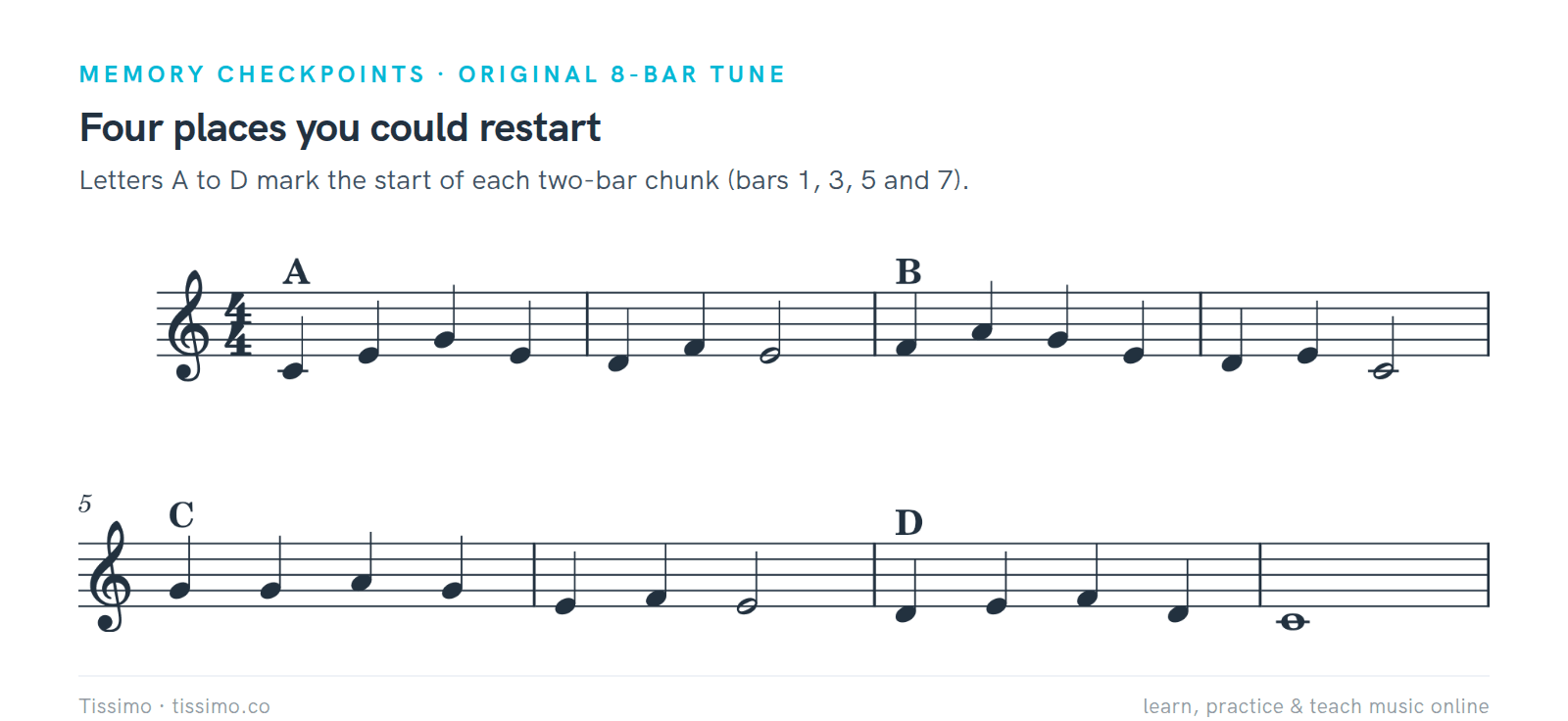
An original eight-bar tune, split into four two-bar chunks. Each letter marks a place to start from.
The Piano Memory: Four Places to Restart handout does this with an eight-bar piece, a cue map and four start cards, and the Start Anywhere exercise tests those starts with the score covered, then again the next day in a new order. The full method is in How to Memorize a Piano Piece: Build Restart Points You Can Test, and How to Memorize Music: A Practical Guide covers the four types of musical memory.
What do you attach to a start? In a well-known case study, the concert pianist Gabriela Imreh recorded her practice as she learned the last movement of Bach's Italian Concerto, and she and the psychologist Roger Chaffin analyzed it (Chaffin and Imreh, 2002). They found that she used the piece's formal structure as a way to retrieve it, and used what they called performance cues as prompts while playing. That is one pianist, so treat it as an illustration, not a rule. As a student-sized version, give each restart point three kinds of cue.

Three kinds of cue to attach to a restart point. The names are simplified for teaching and are not Chaffin and Imreh's exact scheme.
Mock performances: practice the pressure, not only the piece
A run-through alone in your practice room does not feel like a recital, and that gap is part of why stage fright feels so different. A mock performance closes it a little at a time. Start with the easiest audience and add pressure one rung at a time.

A ladder of mock performances. Each rung is one short, complete run-through without stopping.
Two rules make these work. First, do not stop: finish the piece even if it goes wrong, because that is the only way to practice recovering, which we cover below. Second, record at least one of them. A recording lets you judge the playing by what you actually hear, not by how it felt in the moment. Write down one thing to keep and one thing to change, and ask the listener to name one thing they enjoyed.
For a first recital, rehearse the whole trip, not just the music. The My First Recital: Rehearse the Whole Trip handout has you agree on the event facts with your teacher and an adult, walk through arrival, setup, a ready cue, playing, finishing and leaving the playing area, and rehearse it once at home. Parents will find the shared plan in Your Child's First Music Recital: A Plan to Rehearse Together. Fewer unknowns on the day mean fewer things for a nervous mind to grab.
On the day: warm-up, breathing and a ready cue
The day itself should be as dull as you can make it. Eat and drink normally. Do not learn anything new, and do not rewrite your fingering in the car. Give yourself time to arrive, check in and find where to wait.

A day-of routine to rehearse before you need it. Times are a starting point; your teacher and the venue set the real schedule.
Warm up the same way you do at home: slow scales, loose shoulders, the first few bars of your piece at a gentle tempo. If something feels tight, shake out your hands and drop your shoulders before you play more. If there is no instrument to warm up on (common for pianists at recitals), warm your hands, move your fingers through the opening silently on your lap, and hear the first bars in your head. If you play a string or wind instrument, leave time to tune.
Breathe slowly. One common technique is to breathe in through the nose for about four counts and out for about six, five times. At about one count per second, that is ten seconds per breath, or six breaths a minute. A 2018 systematic review of 15 studies by Zaccaro and colleagues, on slow breathing (fewer than 10 breaths a minute) in healthy people, reported links with relaxation and reduced anxiety symptoms alongside changes in heart rate variability. Those studies were not about performers on stage, so use the technique as a way to give your attention something steady to do, not as a promise. Stop if you feel dizzy and go back to breathing normally.
Two other common, low-key tools: on each out-breath, let your shoulders drop and your jaw unclench; and give yourself one short, specific instruction such as "first note, breathe, one bar" in place of "don't mess up." Like the breathing, these are things to try in your mock performances, not treatments.

Five slow breaths: in for about 4, out for about 6. It is one common technique, not a treatment.
Use a ready cue. The My First Recital handout has you choose a ready action, such as looking at your first note and beginning when ready, and check it with your teacher. Before you start, find the first note under your hands, take one breath, and count one bar silently. Taking a moment to set your own pace helps you avoid starting too fast.
Notice when your nerves are loudest (before you start, at a hard passage, or at the end) and write it down afterward. That tells you where to aim your next mock performance.
When a mistake happens
Plan to make one: slips happen to performers at every level. The aim of recovery is not to avoid the mistake but to avoid the second and third ones that come from panicking about the first.
The flow below is short on purpose. Decide it at home, practice it in your mock performances, and your hands will know it when you are nervous.

A mistake-recovery flow. If you are stuck, follow the plan you agreed on with your teacher beforehand.
The most important habit is keeping the beat going in your head, even if your fingers lose it. You can rejoin almost anywhere if you know where the beat is. In the tune below, the player slips on beat 2 of bar 4. Rather than going back, they let the rest of the bar pass and start again on the downbeat of bar 5, which was already one of their restart points.

A slip on beat 2 of bar 4 and a rejoin on the downbeat of bar 5. Notice that rejoining means skipping a note or two, not restarting.
The Recital Ready: What Would You Do Next? exercise uses the same rule in its example plan: after a small slip you can continue from, keep going; if you are stuck, ask for help. Its other scenarios, such as music falling or a first note that is not ready, are worth rehearsing out loud. Do not apologize with your face, and do not restart from the beginning unless your teacher has agreed that is the plan for your event. If it is a formal exam, ask your teacher in advance what is allowed, since rules differ by exam board and by venue.
After: a ten-minute review
How you look back affects how you feel about the next performance. Aim for specific and short, not thorough and harsh. The same evening, write one thing that worked, one thing you would change and one next step, then stop. Do not replay the performance all night. A day or two later, listen to the recording if you made one, and name a bar number and what you heard there. The Recital Ready exercise asks for exactly that after a home rehearsal: a place in the music and an audible detail.

A review that takes about ten minutes, spread over a few days.
Parents have an important role here. Ask what the player enjoyed before you comment on anything else, and let the teacher help choose the single next step. If your child is dreading the next performance more each time rather than less, that is the moment to talk to the teacher and, if it continues, to a professional.
A note for parents and teachers
What helps is mostly practical. Agree on the plan with the teacher in advance so that you and the student say the same things. Rehearse logistics together: where to sit, who gives the starting cue, what happens if the music falls. Keep the day itself calm and the praise specific ("I liked how you waited before the second line") rather than a verdict on the result.
What tends not to help is pressure to be perfect, comparing the student with other performers, or asking a nervous player to "just relax," which gives them nothing to do. Give them a task instead: take one slow breath, find the first note, count one bar. If a young player starts avoiding lessons or performances altogether, or is clearly distressed rather than just nervous, take it seriously, talk to the teacher, and ask a doctor or a mental-health professional who works with young people for advice.
Putting it together
If you take three things from this guide, make them these. Practice restarting, not just playing through. Rehearse the whole performance, including the walk on, at least a few times before the day. And have a plan for the first mistake, because the plan matters more than the mistake. A Tissimo music teacher can run a mock performance with you in a live lesson, listen for where your starts are shaky, and help you rehearse the recovery plan until it feels ordinary. It is also fine to practice with a metronome if you tend to rush when nervous.
Free worksheets for this guide
- My First Recital: Rehearse the Whole Trip — agree on the event facts, walk through the home model from arrival to leaving, and rehearse once
- Recital Ready: What Would You Do Next? — put the trip in order, choose actions for common recital scenarios, and write one observation after a home rehearsal
- Piano Memory: Four Places to Restart — an eight-bar piece cut into four chunks, with a cue map and four start cards
- Start Anywhere: A Piano Memory Check — test the four starts with the score closed, then again tomorrow
- How to Practice — the five-step session, the fix-it loop and the weekly log
Sources
- Kenny, D.T. (2011). The Psychology of Music Performance Anxiety — Oxford University Press
- Kenny, D.T. (2010). "The role of negative emotions in performance anxiety", in P.N. Juslin & J.A. Sloboda (eds.), Handbook of Music and Emotion: Theory, Research, Applications, Oxford University Press, pp. 425–451 (definition, p. 433, as quoted in Herman & Clark (2025), corrigendum, Frontiers in Psychology)
- Twitchell, A.J., Journault, A.-A., Singh, K.K. & Jamieson, J.P. (2025). "A review of music performance anxiety in the lens of stress models" — Frontiers in Psychology
- Fernholz, I. et al. (2019). "Performance anxiety in professional musicians: a systematic review on prevalence, risk factors and clinical treatment effects" — Psychological Medicine
- Osborne, M.S. & Kenny, D.T. (2005). "Development and validation of a music performance anxiety inventory for gifted adolescent musicians" — Journal of Anxiety Disorders
- Papageorgi, I., Hallam, S. & Welch, G.F. (2007). "A conceptual framework for understanding musical performance anxiety" — Research Studies in Music Education
- Chaffin, R. & Imreh, G. (2002). "Practicing perfection: piano performance as expert memory" — Psychological Science
- Zaccaro, A. et al. (2018). "How breath-control can change your life: a systematic review on psycho-physiological correlates of slow breathing" — Frontiers in Human Neuroscience
- Kinney, C. et al. (2025). "Therapeutic interventions for music performance anxiety: a systematic review and narrative synthesis" — Behavioral Sciences
- Mental health support at BAPAM — British Association for Performing Arts Medicine
Read this article online: https://tissimo.co/articles/stage-fright-how-musicians-manage-performance-nerves




Comments