 Back

How to Sing Harmony: A Beginner's Guide
Sing along with a song on the radio and you are singing the melody. Add a second line a little above or below it, and the same song suddenly has depth: two voices, one tune, and a sound that neither could make alone. That second line is a harmony, and most beginners are closer to singing one than they think. This guide shows you what harmony singing is, how to find a note a third above or below a melody, how to use a drone or a keyboard to check yourself, and how to practice a simple duet so that you can keep your own line when the melody pulls at you.
What harmony singing actually is
Harmony, in the broadest sense, is about different pitches sounding together. In vocal harmony, one singer carries the main melody while others sing consonant notes alongside it. Wikipedia's article on vocal harmony describes the simplest version as a main melody supported by one backup line, above or below it, often in thirds or sixths. A barbershop quartet, by comparison, sings a melody line (normally the lead) plus three harmony parts.
Compare that with two other ways of singing together. In unison, every singer sings the same pitch. In an octave duet, one singer sits exactly an octave (eight letter names, 12 half steps) above the other; many musicians still call this singing in unison, and it sounds like one fuller voice. Harmony is different because the second singer lands on a different note name altogether, so the listener hears two lines at once.
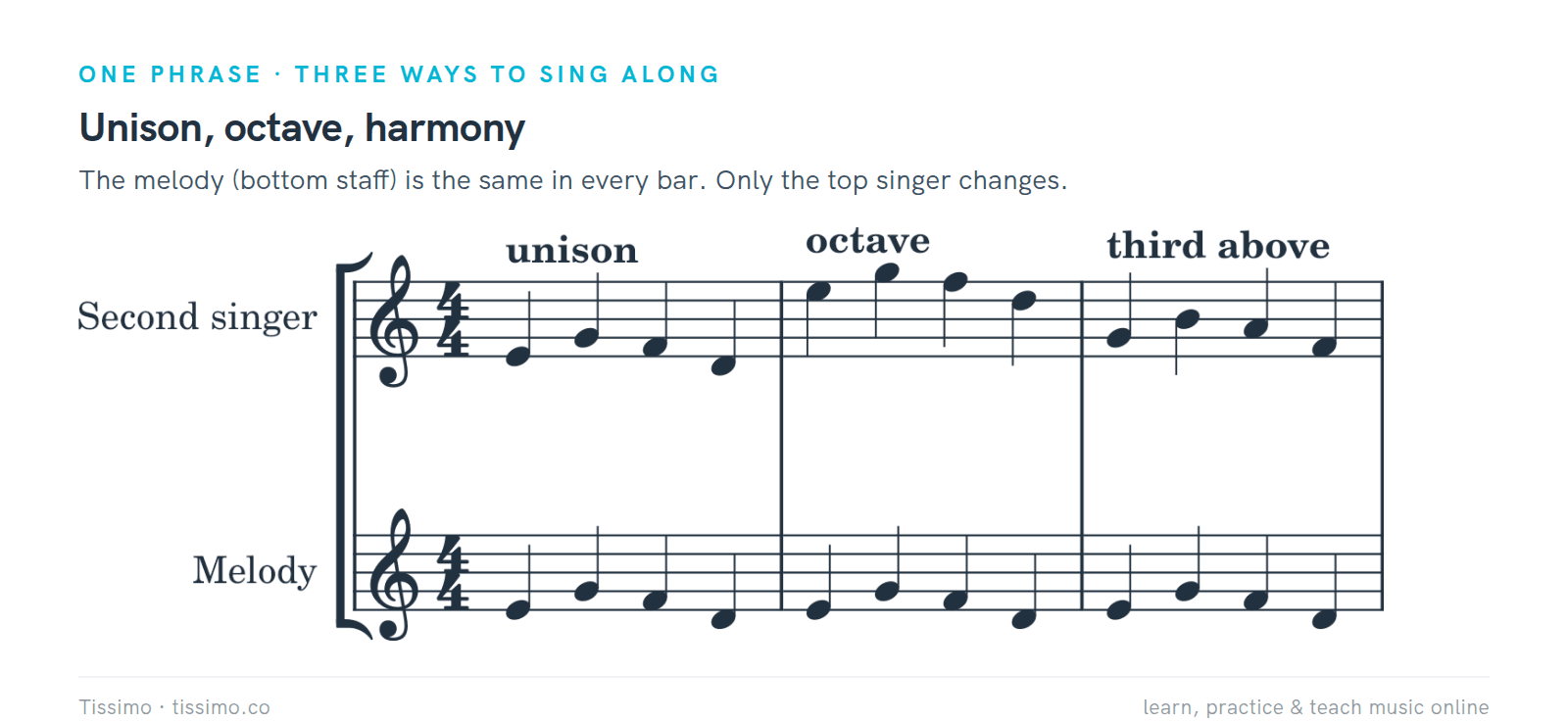
The same four-note phrase three ways. Bar 1: unison. Bar 2: the top singer an octave up (E5 G5 F5 D5). Bar 3: the top singer a third above each melody note (G B A F), which is harmony.
Singing in unison is the best place to start, and it is not a lesser skill. If you cannot match a pitch you hear, a harmony line will drift. The singing basics guide covers posture, breath and a gentle warm-up; do that first, and if you are not sure where your comfortable range sits, voice types and how to find your vocal range will help you choose whether to sing above or below the melody.
Why thirds and sixths
Not every pair of notes blends the same way. Our own Hearing intervals worksheet sorts intervals by how they sound together: open (perfect 4th, 5th and octave), sweet (minor and major 3rds and 6ths, "full and warm, like two voices singing in harmony"), clashing (2nds and 7ths) and the restless tritone. Music theory agrees about the sweet group: major and minor thirds and sixths are called imperfect consonances, and the open textbook Open Music Theory says they can be used relatively freely when writing two voices together (see also consonance and dissonance).

Four families of intervals, grouped as on the Hearing intervals worksheet. Harmony singing lives mostly in the sweet family.
If an interval name is new, the music intervals explained article walks through counting and naming. The short version you need today: to find an interval's number, count every letter from the lower note to the higher, counting both ends. C up to E is C-D-E: three letters, a third. The worksheet Intervals: steps & skips drills exactly this, calling a 2nd a step and a 3rd a skip. A sixth works the same way (C to A is six letters), and The 6th, the 7th & the Octave describes it as warm and singing.

The top of the Hearing intervals worksheet: four steps for naming an interval by ear, then a song or a trick for each interval, going up and coming down.
The wording "major" or "minor" matters less to a singer than it first seems. Both sound good. In a given key, which one you get is decided by the notes of the scale, not by a choice you make.
Find a third above a melody note
Here is the method, using C major so that every note is a white key.
- Name the melody note.
- Count up three letters, counting the melody note as one. E is the melody; E-F-G: the harmony is G.
- Use only notes that belong to the key. In C major that means no sharps or flats.
That is the whole procedure. Run it on the C major scale and you get the pairs below. Because the key stays the same, some thirds are major (four half steps) and some are minor (three half steps): C-E, F-A and G-B are major; D-F, E-G, A-C and B-D are minor.
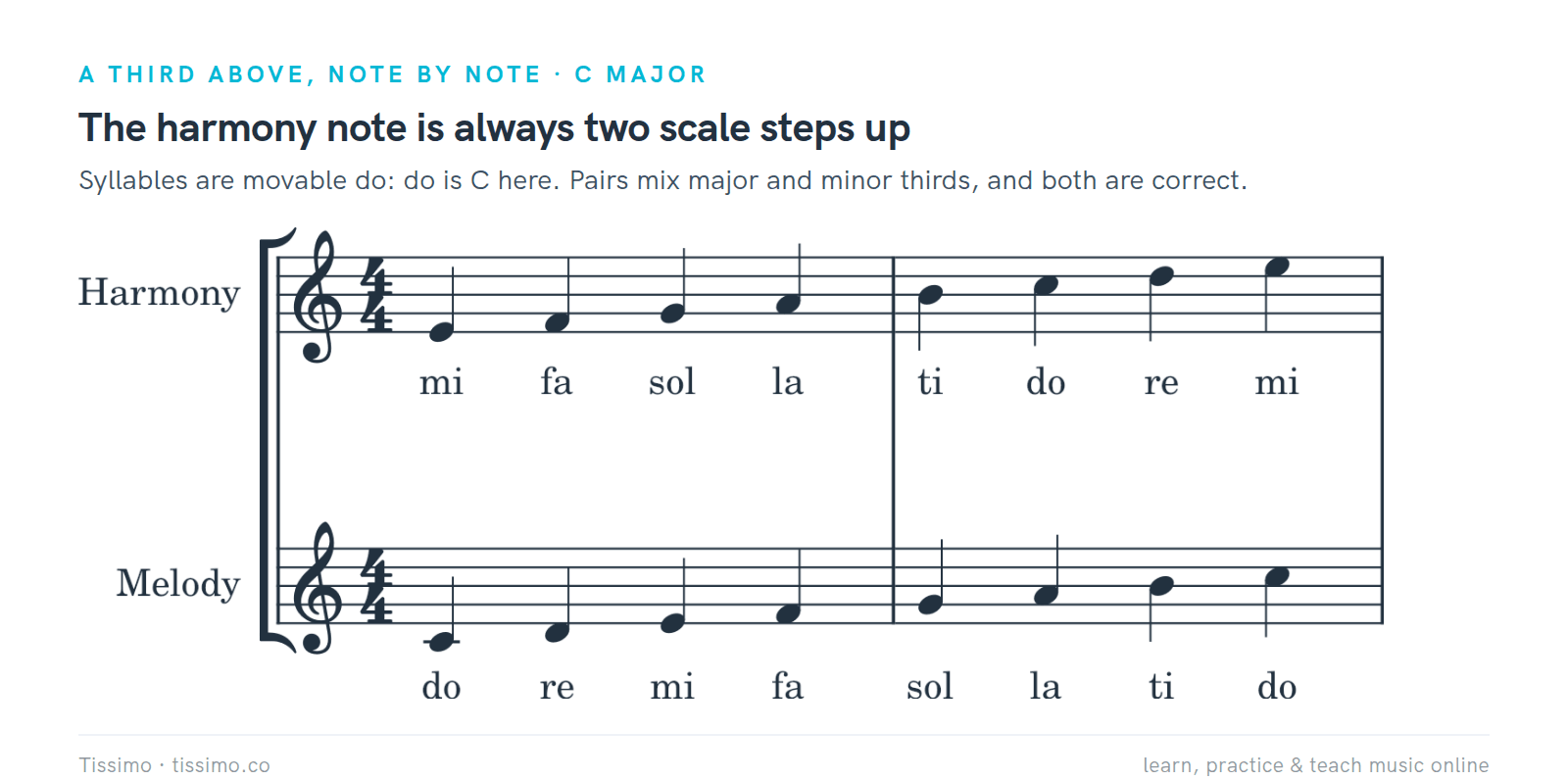
The C major scale (bottom staff) with a third above each note (top staff). Each bar runs M3, m3, m3, M3. Syllables are movable do, so do is C here.
Other keys work the same way; the key signature does the bookkeeping. Here is a short melody in G major, which has one sharp (F♯). The third above D is F♯, and the third above E is G.

A melody in G major (bottom staff) with a third above (top staff). F♯ is in the key signature, so every F is sung as F♯, and the pairs are still all major or minor thirds.
In C major the keyboard map is easy to see: skip one white key. In G major the same skip from D lands on the black key F♯. If you play along, you can hear each pair before you sing it.

A third above, drawn on a keyboard: each arc skips one white key. Cyan arcs are major thirds, coral arcs minor thirds.
Notice the syllables in the C major scale figure. In movable do, the harmony line starts on mi when the melody starts on do. If you sing with solfege, the solfege explained article shows how the syllables move with the key, and the worksheet Movable Do: The First Five Notes gives you do, re, mi, fa and sol in C, G and F major to read and sing.
Sing the melody first, then the third
Learn the melody until you can sing it without hearing it. This is not optional: you will sing your harmony against a melody that is either played, sung by a partner, or running in your head. Here is an original four-bar melody in C major, with a third above it.

An original melody (bottom staff) with a third above (top staff). Every pair is a major or minor third; the melody ends on C with E above it.
A reliable practice order:
- Sing the melody on its own, with the syllables if you like.
- Play the harmony line alone on a keyboard. Hear it as a tune.
- Sing the harmony slowly while you play the melody on the keyboard as a guide.
- Swap: sing the melody while the keyboard plays the harmony.
- Sing your harmony against the melody played at a steady tempo.
Step 2 is the one people are tempted to skip, and it is the step that makes the harmony yours rather than a shadow of the melody. If you want to sing the syllables first and check against a model afterward, the worksheet Sing Before the Model: Movable Do 1 trains exactly that habit: add the missing syllables, sing from a tonic reference, then play the model.
Harmonizing by ear
You do not always have written music. Put on a recording that already has a harmony part and sing along with the melody first. Then play the song again and listen for the second line, and hum along with it. When you can hum it, find its first note on a keyboard and work out whether it sits above or below the melody there. Keep going phrase by phrase, and compare what you hear with the third-above method; often they agree.
A third below
You can also put the harmony under the melody. The method is the same counted downward: E is the melody, E-D-C, so the harmony is C. In the next figure the melody moves to the top staff and the harmony goes underneath.
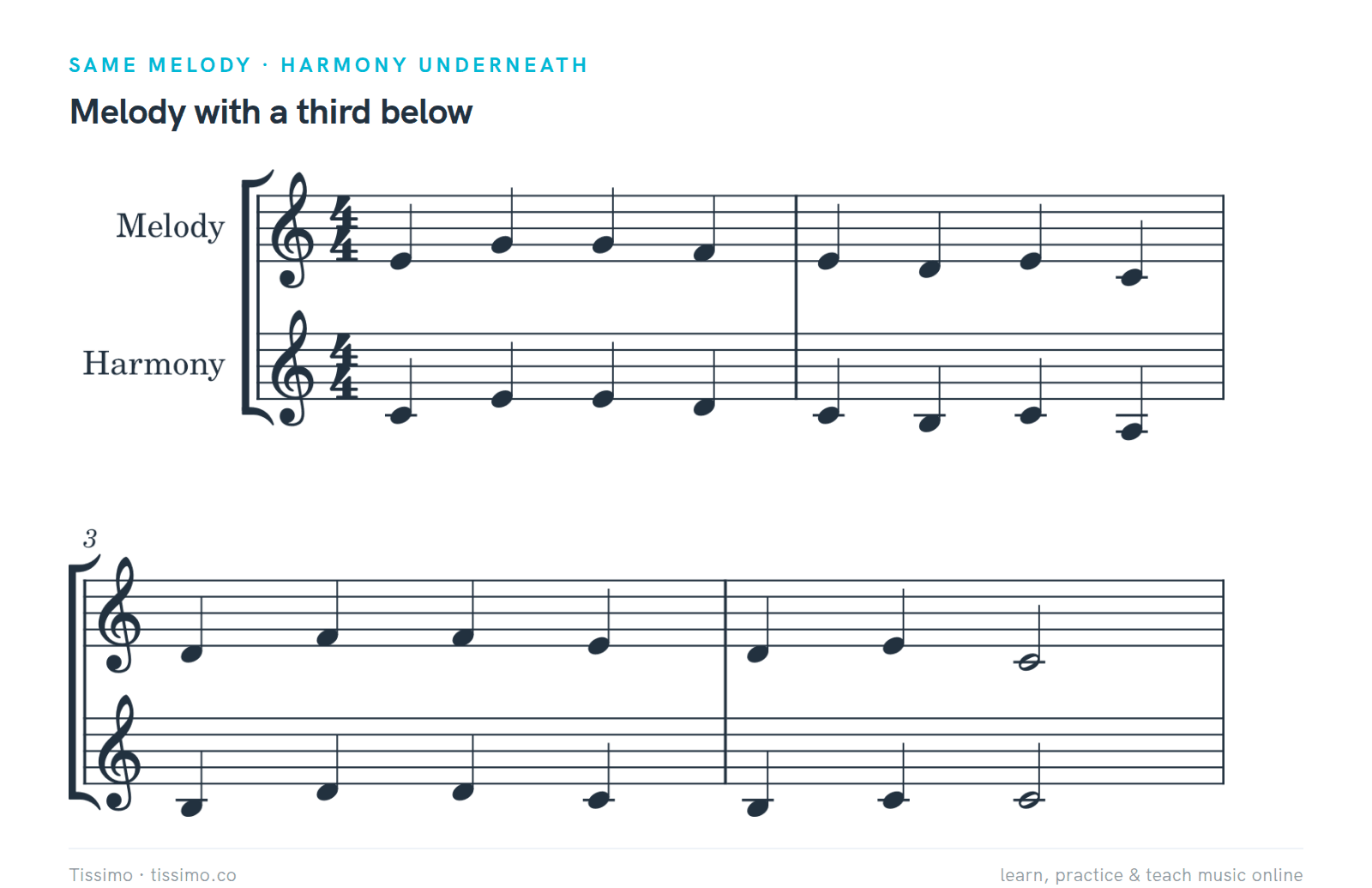
The same melody (top) with a third below (bottom). In bars 2–4 the harmony dips below middle C (B3, and A3 in bar 2). On the last note the harmony joins the melody on C. If that is too low for you, sing the melody and let someone else take the lower part.
Choosing above or below is a practical choice about range, not a ranking. Sing the one that sits comfortably. If a note feels strained, stop, rest, and choose another line or another key.
Use a drone or a keyboard
A drone is a note held continuously while other notes move around it. As Wikipedia's drone article puts it, a drone is a harmonic or monophonic effect or accompaniment in which a note or chord sounds continuously throughout most or all of a piece; it is most often placed on the tonic or dominant, and it can be vocal as well as instrumental. The same article notes that drones are used by music education programs for ear training and pitch awareness. For harmony practice that is the useful job: it gives your ear a fixed home.
Hold the tonic (C for our examples) on a keyboard, a tuner app or a friend's sustained voice, and sing the five notes from C up to G one at a time, as in the figure below. Compare each with the drone. Unison should sound like one note. The third (mi) should sound sweet; the second should feel tight against the drone; the fifth should sound open.
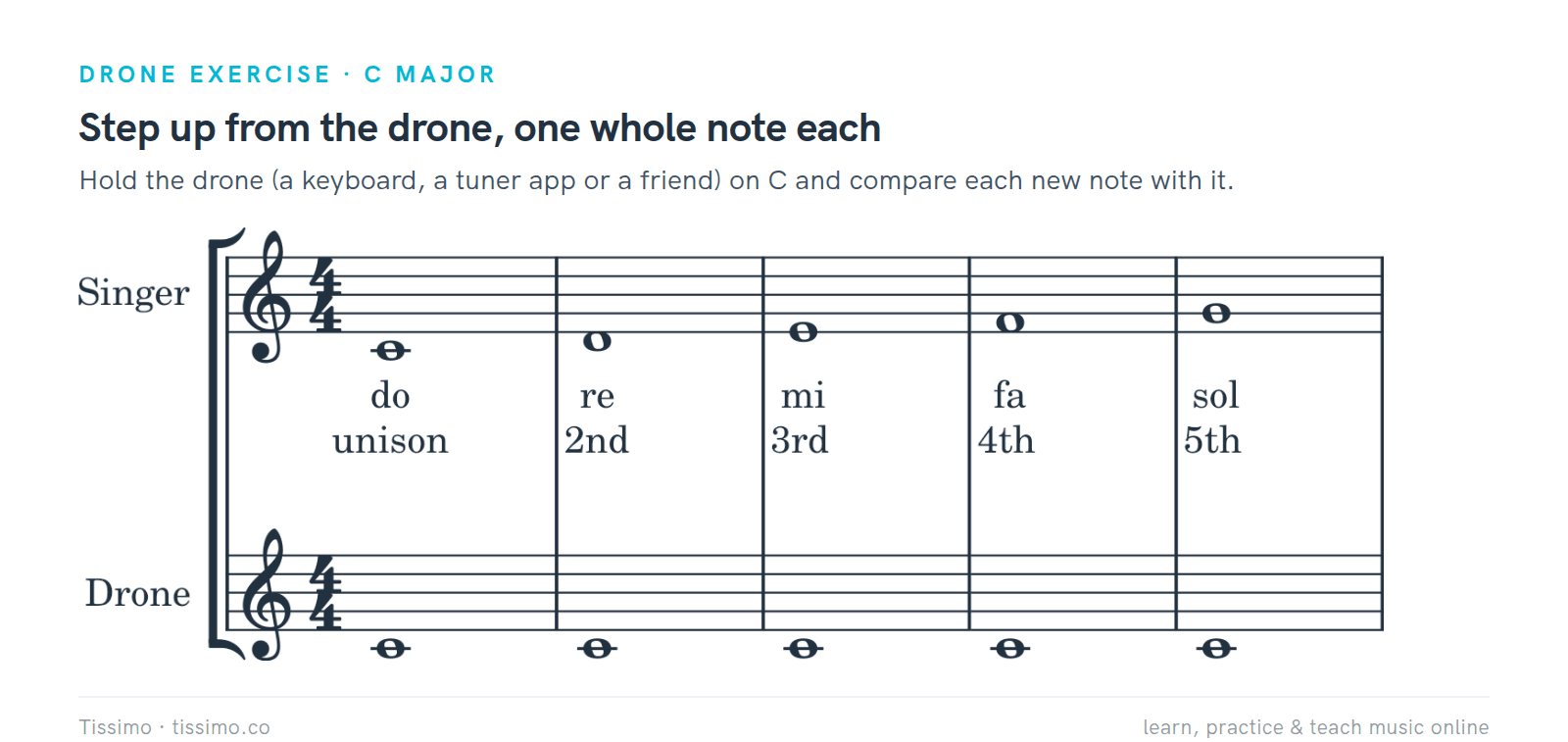
Steps above a drone. Hold C on a keyboard or app and sing each whole note, listening to how it sits against the drone.
When two nearby pitches sound together, you can hear a slow pulse called beats; it slows as the pitches get closer and disappears when they match. The worksheet Hear the Pulse Between Two Tones demonstrates this with steady tones (440 Hz against 441 Hz gives one beat per second), and it notes that real instruments, vibrato and recordings can complicate the pulsing. On a drone, listen first for the unison: sing the drone's note, drift a little off it, and listen for a slow wobble that fades as you settle back onto it.
A keyboard does the same job for a whole melody: play your harmony line one note at a time before you sing it, and keep a hand on the melody while you learn.
Parallel thirds and sixths
When both voices move in the same direction and keep the same generic interval between them (a third stays a third, major or minor), the lines are in parallel motion; Open Music Theory contrasts it with similar, contrary and oblique motion. Singing a third above a melody all the way through is exactly that. It is the easiest harmony to learn: start from the melody and the key, then check each harmony note against the chord underneath.
That last check matters whenever the song has chords. Wikipedia's vocal harmony article describes the backup line as often in thirds or sixths "which fit in with the chord progression used in the song." A third above usually lands on another note of the chord, but not always. Take the melody note C over an F chord (F, A, C): the strict third above is E, which is not in an F chord and rubs against the chord's root, F. Singers then move the harmony note to the nearest chord tone (here F), or hold the previous note.

Chords C, F, G, C. Every harmony note is a third above except the middle of bar 2, where the strict third (E) would clash with the F chord, so the harmony sits on F instead.
A sixth below the melody is the same idea with a wider gap. A sixth below sits on the same letter names as a third above, one octave lower, so you can think of it as a third above sung in a lower register.
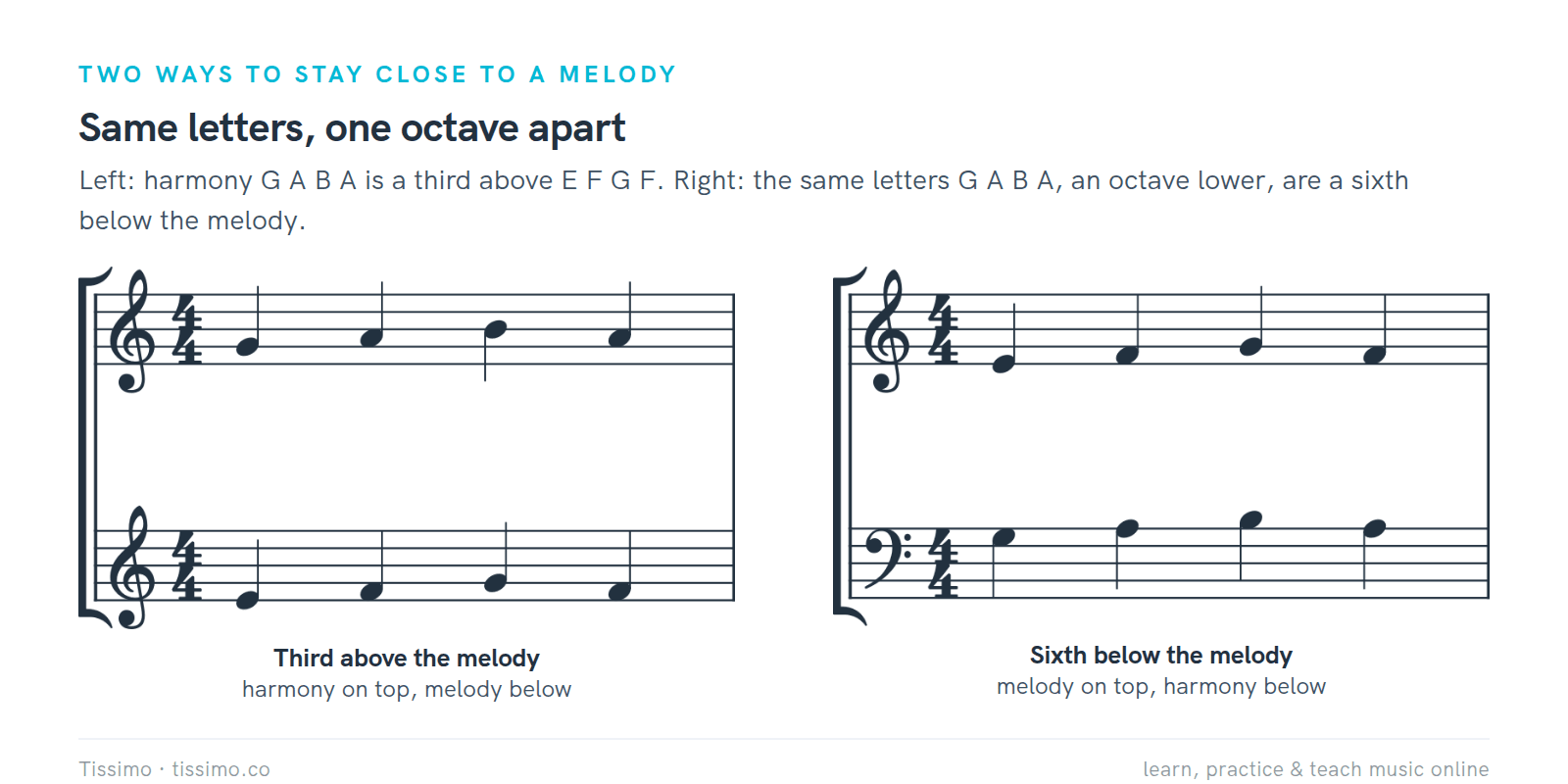
Left: harmony G A B A is a third above E F G F. Right: the same letters G A B A, an octave lower and in the bass clef, form a sixth below the same melody.
Parallel thirds are not the only choice. Species counterpoint, the traditional way of teaching part-writing, avoids parallel fifths and octaves and even limits parallel thirds or sixths to about three in a row. Simple vocal harmony is freer: long runs of thirds and sixths are common. Voices also usually keep their order: when a lower voice crosses above an upper one, the lines can become harder to tell apart, which is why voice crossing is sometimes avoided in teaching exercises. In practice, for a beginner duet, keep your part either above or below the melody for the whole song, and finish on the melody's note or on a stable third above it.
For a taste of two lines overlapping in thirds, try One Melody, Two Entrances: a four-bar leader melody is imitated two bars later by a follower, and in the overlap bars every simultaneous pair is a third.
Hold your part
This is where harmony singing gets hard: the melody is right there, and your ear wants to follow it. A few habits make a big difference.
- Know your line independently. Sing it alone, from memory, before you ever add the melody.
- Match vowel and volume. Sing the same vowel as the melody singer, and keep your volume slightly below theirs for now so you can hear them.
- Hear the melody inside. While you sing harmony, silently sing the melody in your head. Your ear then has the interval to check against.
- Aim at the next note, not the last one. Before each new note, hear it in your head. Hearing a note before you sing it is the skill that ear training for beginners develops.
- Record yourself. Play back a short phrase, mark where you slid toward the melody, and fix only that bar.

Five habits for keeping your own line.
Gentle warm-ups help. The worksheet My Comfortable Warmup is a short teacher-chosen pattern of three notes (1-2-3-2-1) sung as a hum and then on a vowel, with rests, which is a good place to settle before you sing a part.
A short duet
Here is a short duet to practice. Singer 1 takes the top line, Singer 2 the bottom. Both lines move in thirds for three bars, then meet on the final C.

A duet in parallel thirds. Singer 1: E G F E, A G F E, D F E D, then C. Singer 2: C E D C, F E D C, B D C B, then C. In bar 4 the two lines meet on one note: Singer 1 steps down from D and Singer 2 steps up from B.
A four-week duet practice plan
Pick a partner (a friend, a teacher, or recordings of each part) and work through this plan. Ten to fifteen minutes a day is plenty.
- Week 1: melody and drone. Sing Singer 1's line (the melody) with a drone on the tonic, C. Name each note in solfege or letter names.
- Week 2: your part alone. Learn Singer 2's line (the harmony) on a keyboard, then sing it slowly on its own.
- Week 3: duet. Check your tuning on a shared C first, then sing the duet as written. Stop when the sound wobbles and find the bar.
- Week 4: swap and record. Trade parts, record both versions and listen back.

A four-week plan, about 10 to 15 minutes a day. Warm up first and finish by singing the whole duet once.
Work in short passes. First, speak the rhythm together. Then sing bar 1 on "doo", and add one bar at a time. If you lose your place, go back to the drone note and start the bar again.
Free worksheets for this lesson
- Intervals: steps & skips — count 2nds and 3rds by letter and compare them
- The 6th, the 7th & the Octave — the wide intervals, with the 6th described as warm and singing
- Hearing intervals — a song or a trick for every interval, and the four sound families
- Movable Do: The First Five Notes — do, re, mi, fa, sol in C, G and F major
- Sing Before the Model: Movable Do 1 — add syllables, sing, then check against the model
- My Comfortable Warmup — a short three-note hum and vowel pattern with rests
- One Melody, Two Entrances — a canon where overlapping bars form thirds
- Hear the Pulse Between Two Tones — hear the beats between two close tones
Keep singing together
Harmony is a habit of listening more than a skill of singing higher or lower. Start with the melody until it is secure, add a line in thirds, check against a drone, and keep each part short and slow until the interval locks in. A Tissimo voice teacher can listen to your line in a live lesson and tell you whether you are drifting toward the melody or settling in the right place.
Sources
Read this article online: https://tissimo.co/articles/how-to-sing-harmony-a-beginners-guide




Comments