 Back

First Flute Double Tonguing: Alternate Two Articulations on One Note
Double tonguing is a milestone on the flute. Once you can alternate two tongue positions on a single note, passages that would tire a single-tonguing player stay easy and clear. But the first lesson is not about speed. It is about learning that the back of your tongue can start a note just as cleanly as the front — and then alternating those two actions on G4 until they feel as natural as breathing.
This article covers the whole first session: confirming your single note, understanding what T and K actually are, letting your teacher demonstrate the K attack, and building up from one pair to a full bar of eight even onsets.

T K T K T K T K — eight G4 eighth notes, each one a sounding note. The syllables are tongue cues, not spoken words. Every T and every K begins a full note.
Start with what you already have
Before you introduce anything new, return to the note you know well. Play G4 four times as quarter notes at a comfortable tempo, say quarter = 60. Single tongue each one — T, T, T, T — and listen for a clean, even onset on every note. Tempo and the Metronome gives the Italian words for common speeds and shows how to use a metronome to keep that reference steady.

G4 as four quarter notes, each started with T. This is the foundation. If any onset feels uncertain or the tone cuts out, stay here until G4 is reliable before adding K.
You are not just warming up. You are establishing the baseline: a stable G4, four beats, one attack per note. If any onset feels uncertain or the note cuts out mid-duration, stay with single tonguing until it is reliable. Your teacher should hear this before you move on — double tonguing requires a solid single note first.
The counting matters here too. Four quarter notes at quarter = 60 fill four beats exactly. If you rush beats 3 and 4, or let the last note trail off early, that unevenness carries straight into the double-tongue exercise. The Rests is a useful refresher if the rest between repetitions feels uncomfortable to count — a rest is not empty time, it is counted silence at the same steady beat.
If G4 is not yet reliable as a single note, this is the moment to address that before moving on. A shaky G4 will not become stable once you add the complexity of alternating tongue positions. The two skills — reliable tone production and alternating tongue positions — must be built in sequence, not simultaneously. Take the time on G4 single-tongue now, and the double-tongue introduction that follows will go more quickly.
T and K are two different tongue positions, not two different notes
Here is where many players get confused. They hear "double tonguing" and think of speed. Or they try to produce K by muffling the note somehow, as if K were a quieter or shorter version of T. Neither is right.
T is the front of your tongue. When you say "ta," the tip of your tongue taps briefly behind your upper teeth, then pulls back to release the airstream. That release starts the note. G4 sounds.
K is the back of your tongue. When you say "ka," the back of your tongue lifts toward the roof of your mouth — the soft palate — and then drops away. That drop releases the airstream just as the T does. G4 sounds again, from the exact same pitch, same volume, same duration.

T and K are two different places where the tongue briefly blocks and then releases the airstream. The note produced — G4, pitch 67 on the MIDI scale — is the same either way.
Neither T nor K creates silence. Neither is a slur. A slur connects two different pitches smoothly, without a new tongue attack between them — Ties vs Slurs explains the distinction clearly. Double tonguing on a single note is the opposite: every note gets a fresh attack, and the attacks simply come from alternating positions.
Both T and K are attacks. Every syllable in "T K T K" starts a sounding note.

A slurred group: one attack at the start, then the notes connect. Double tonguing is the opposite — T K T K means a fresh attack on every note. These are different techniques and are not interchangeable.
Let your teacher model the K attack first
You should not try to figure out K on your own from a description. Tongue position varies between players, and the exact spot where the back of the tongue creates the cleanest release differs by anatomy. Your teacher's job at this stage is to play K for you — not explained, demonstrated — so you can hear that it produces the same note as T.
Ask your teacher to play a single K on G4. Then a pair: T, K. Then a bar of T K T K T K T K. Listen for evenness. Both syllables should produce a note of the same length and the same tone onset. If K sounds muffled, shorter, or missing in your teacher's demonstration, the position needs adjustment — but that is the teacher's problem to solve in their own technique, not yours. When K sounds exactly like T in the model, you are ready to try.
Two attacks at a time
Start with a single pair. One T, one K, then a rest. At quarter = 60, make both notes eighth notes: T on the "one," K on the "and-of-one," then a half-note rest to complete the bar. The Rests reviews how rests are counted — the half rest gets beats 2 and 3, the quarter rest gets beat 4, and you count all of them silently while holding still.

One pair, then rest. T on beat 1, K on the "and," three beats of rest (half rest + quarter rest). Count through the rest at the same tempo. This gives your ear time to process the K before you need another one.
Go slowly at first. The goal is not to play K quickly — it is to produce K once, hear that it started a note, and confirm that G4 still sounded. If your K feels like a cough or a grunt, that is a pressure issue: the back of the tongue should move with the same light, brief tap as the tip of the tongue in a T.
Before pairing T with K, try K alone. Play four G4 quarter notes, each started with K and nothing else. This isolates the back-tongue motion completely and removes any tendency to let the T carry K through the bar. If you can play K K K K and hear four clean, identical onsets, you are ready to alternate. If K alone does not produce a reliable onset, the back of your tongue is not yet committing fully to the release — stay on the K-only drill until each note sounds before adding T back into the sequence.

K alone on G4. Four quarter notes, each started with K. If these sound as clear as the T-only bar from the first section, you are ready to pair them.
Once a single pair feels steady, add a second pair. T K | T K, with a rest at the end if the bar is not yet full. Listen: is the spacing between T and K equal to the spacing between K and T? If K rushes, slow down. Rushing K is the most common problem at this stage, and the cure is always to slow down, not to try harder.

Eight onsets, equally spaced in time. The color shows which tongue position produced each one, but on G4 the sound is identical either way. Even spacing is the goal — each gap the same width.
Extend to four pairs
Once you can play T K twice in a row with even spacing, you are ready for the full exercise: T K T K T K T K across one 4/4 bar of eighth notes, followed by a whole rest.
First look at the attack bar by itself, without the rest appended:

Just the attack bar. Before adding the rest bar, confirm that all eight onsets sit evenly inside one 4/4 measure.
Once you are satisfied that the eight onsets are even, add the whole-rest bar immediately after to make the two-bar unit. The printed reference for this session, Two Articulations, Even Notes (Handout 476), prints this same T K T K T K T K attack bar above a T-only line for comparison, with a mini-key reminding you that K is an attack and not silence:

The two-bar unit: the handout's attack bar (bar 1) followed by a whole-rest bar (bar 2). The rest bar is part of the exercise, not a gap between repetitions. Count it at the same steady tempo before playing the attack bar again.
The whole rest is not a break. It is part of the exercise. You count it at exactly the same tempo, and you use it to reset: check your jaw (no tension), check your embouchure (settled), check your air (steady). Then repeat the bar.
Compare this to the all-T version:
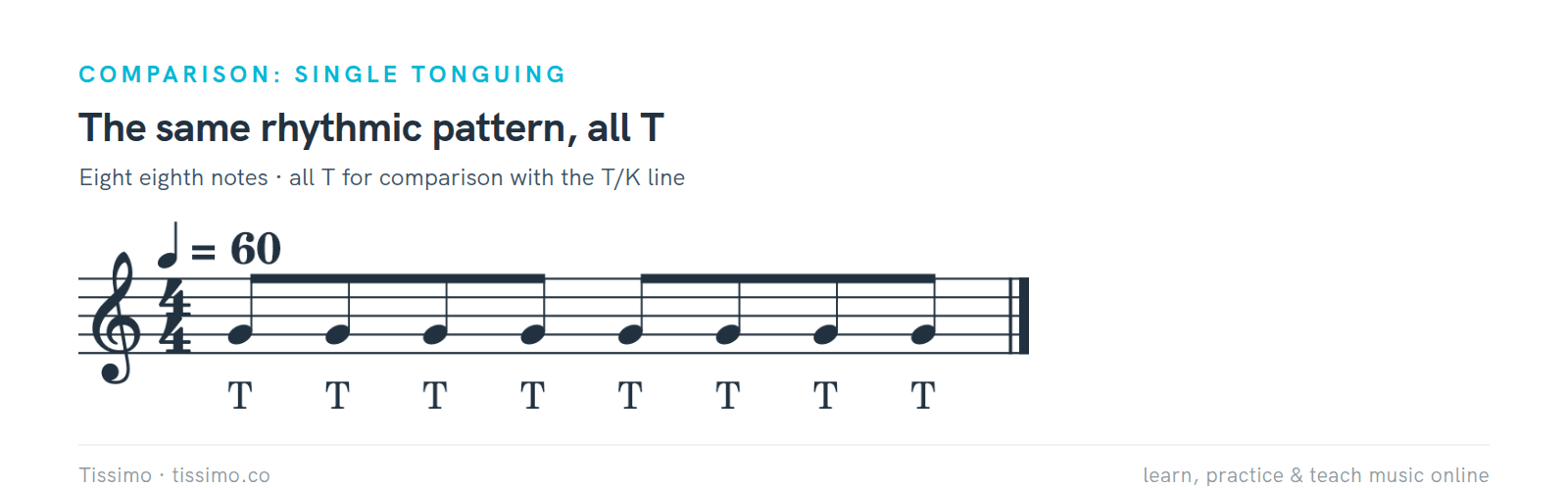
The same rhythm with only T. Both lines produce eight equal onsets. The T/K line alternates tongue positions; the T-only line does not. The spacing goal is identical.
T-only gives you an honest comparison: if the T K line sounds uneven next to the T-only line, K is rushing or dragging. Bring them back together by slowing the T K line until both feel equally easy.

Five stages of the first session. You do not need to reach stage five in a single lesson — some players take two or three lessons to establish a clean K. That is normal.
Stop and rest before repeating
The pattern your teacher watches for is a bar of eight followed by a complete rest, not a continuous loop. Why? Because continuous looping disguises two problems.
The first is fatigue. The back of the tongue gets tired faster than the tip, because you use it much less often in everyday speech. Playing through the tiredness produces a K that gradually gets softer and softer until it disappears entirely. Playing the bar, resting a full bar, then playing again keeps K fresh.
The second is restarting count. In this exercise, every bar starts with T. The first attack is always T. A rest bar gives you a natural reset so you start each bar fresh with T.

T K followed by a rest, then T K again. Each pair restarts at T. A rest does not consume a cue — the pattern after the rest starts fresh with T, not K.
This restart rule matters most when you move to written exercises like Which Articulation Comes Next? (Exercise 180). Each card in that fill-in exercise starts T regardless of how many attacks it contains: a card with six attacks is T K T K T K — not T K T K K T. The same sheet then asks you to spot the first wrong cue in a scrambled sequence, and gives your teacher a two-attempt box to check evenness, clarity, and comfort. Rest beats inside a bar do not advance the T/K count; only sounding notes do.
Compare evenness and clarity, not speed
The last step of the first session is comparison, not advancement. You and your teacher listen to the bar of T K T K T K T K and ask three questions:
Are all eight onsets equally spaced? Uneven spacing means K is coming too early or too late. Slow down until the spacing locks in.
Does every note sound fully? A K that barely sounds, or that produces a note obviously shorter than the T before it, is not a K yet — it is a half-action. The back of the tongue needs to commit to the same full, brief tap as the front.
Does it feel comfortable? If the jaw is tense or the throat feels tight, something is being forced. Double tonguing at a slow tempo should feel easy — almost like talking slowly. The tension comes from trying to reproduce speed before the basic motion is comfortable.

Single and double tonguing side by side. Neither is better — they are tools for different situations. Double tonguing gives more options; it does not replace single tonguing.
Do not chase speed. The tempo for this first session is whatever gives you a clean K. For most players at the beginning, that is quarter = 60 or even slower. Speed comes from repetition over days and weeks, not from one long practice session. Tempo and the Metronome explains the practice ramp: small steps, consistent tempo reference.
Here is the exercise bar one more time, at standard width, as a reference for the evenness check:

The T K T K T K T K bar. Each onset — whether T or K — should occupy the same width in time as every other. A K that lands late or early is clearly visible if you record yourself and watch the waveform; it is often audible too.
A practical practice approach: three repetitions of the two-bar unit (attack bar + rest bar), then stop and rest for a minute or two. Do not run twenty repetitions in a row. The back tongue fatigues faster than the front because it is less practiced, and a fatigued K will sound different from a rested K. Short bursts with genuine rests between them build the muscle memory faster than long continuous drills.
Moving to a second note
Once T K T K T K T K on G4 is clean, repeatable, and comfortable, you can carry the same technique to A4. The tongue mechanics do not change. Only the fingers change.

G4 and A4 as single-tongued quarter notes, one bar each. You already know both notes. Double tonguing carries over to A4 the same way.
The K syllable position does not need to shift between G4 and A4. The note changes, but the tongue position stays the same. This is what makes double tonguing a general technique rather than a note-specific trick — you learn it once, on G4, and it transfers.

The same alternating pattern on A4. This is a second-session task, not a first-session one. Confirm G4 is clean before moving here.
Only move to A4 when your teacher confirms that G4 is clean. Some players have G4 ready after one session; others take two or three. Either is normal.
A note about the teacher's role
Almost everything in this article depends on your teacher. The K attack position cannot be reliably self-taught from a description alone — the anatomy is individual, and the exact location where the back of the tongue creates the cleanest release is slightly different for every player. Your teacher models it, listens while you try, and adjusts your position in real time. An online piano reference track can check your rhythm (eight equal onsets at quarter = 60) but cannot check your tongue position or the clarity of your K.
A good teacher also sets the tempo. They know what a slow-enough K sounds like for a student at this stage, and they will prevent you from raising the tempo before K is stable. Speed is easy to add once the alternation is clean; it is very difficult to fix unevenness that has been practiced in at the wrong speed. If your teacher slows you down to quarter = 40 or even 30, trust the process — the speed will come later.
If you do not have a flute teacher yet, finding one for even a few sessions makes a large difference at this stage. A Tissimo teacher can hear your T and K live and tell you in real time whether K is producing a note or not — something no written description or recording can do.

Four things a teacher listens for in the first T/K bar. Evenness and count are the most important at the start. Clarity and comfort come from repetition.
Free worksheets for this lesson
The exercises and reference sheet that go with this article are available as free printable PDFs on the Tissimo worksheet library.
- Ties vs Slurs — distinguishes the slur (smooth connection between different pitches) from an attack. Useful background before starting T/K work.
- Tempo and the Metronome — Italian speed words, how to set a metronome, and the practice ramp from slow to fast.
- The Rests — every rest symbol and how to count rests at a steady tempo. Keeping the beat through the whole-rest bar is part of the exercise.
- Two Articulations, Even Notes (Handout 476) — the reference sheet for this session: a T/K attack legend, the eight-note T K T K T K T K exercise bar, and a T-only line for comparison, with a mini-key and a whisper-first warm-up.
- Which Articulation Comes Next? (Exercise 180) — a fill-in exercise for the alternating sequence, a find-the-first-break drill, and a teacher-observed two-attempt four-pair check.
Sources
- UWYO Flute Learning Sequence — University of Wyoming, Nicole Riner — Places initial double tonguing at the intermediate level, explicitly after single-tongue reliability. Names the T/K syllable system.
- Double Tonguing Demonstration — Nancy Stagnitta, Interlochen Arts Academy — Teacher-demonstration of both T and K attacks on a single note, used in the GAPS.md brief as an independent source confirming the technique.
- Flute Acoustics — University of New South Wales, Joe Wolfe — Physics of flute tone production, airstream release, and pitch. Source for the description of how tongue position affects airstream onset.
- General MIDI Specification — MIDI Manufacturers Association — MIDI note numbering system: G4 = MIDI 67, verified by formula 12×(4+1)+7.
- Flute — Wikipedia — Overview of flute playing technique including tonguing. Confirms single and double tonguing as the two primary articulation modes used in standard flute pedagogy.
- Ties vs Slurs — Tissimo — Defines ties (same pitch, held) and slurs (different pitches, smooth connection). Used to distinguish the slur from a double-tongue attack.
- Tempo and the Metronome — Tissimo — Practice tempo reference (quarter = 60) and the practice ramp concept.
- The Rests — Tissimo — Rest notation and counting through rest bars at a steady tempo.
Read this article online: https://tissimo.co/articles/flute-first-double-tonguing-one-note




Comments