 Back

Electronic Dance Music Explained: Styles, Beats, Build-Ups and Drops
Tap one bar of four steady beats. Count the next four-beat bar without tapping, then bring your hand back on beat 1 of the third bar. That is a first arranging skill behind a breakdown and a drop: you keep the pulse while the sounding layers change.
Electronic dance music, or EDM, is a broad family of electronically produced music made for dancing. Here you will compare five listening families, build an original drum pattern, and develop a small musical idea into a 64-bar sketch. You can start with hands and voice; software comes later.
EDM begins with people and dance floors
“EDM” can mean the broad umbrella containing house, techno, trance, drum and bass, dubstep and more. In commercial contexts it can also suggest a narrower festival sound. Native Instruments’ drum-and-bass tutorial acknowledges those commercial connotations. Ask which meaning someone intends; electronic music also includes work designed for listening rather than dancing.
House grew through Chicago’s Black and gay disco communities. In WTTW’s participant interviews, Donald Crossley recalls friends creating parties after visiting New York loft gatherings. US Studio’s audiences included Black and Latino gay dancers; Frankie Knuckles arrived in Chicago in 1977 and helped shape the Warehouse’s sound. That history involves organizers, dancers and several DJs, rather than one person inventing everything.

Two historical routes into electronic dance music. WTTW supplies the Chicago participant accounts; Cornelius Harris names the four early Detroit musicians; MSU Museum supplies the Afrofuturism context. Read these as communities and creative practices, not a claim that one genre simply replaced the other. When comparing recordings, listen for how repetition supports dancing and how small changes reward continued attention.
Detroit techno developed in the early 1980s through a wider Black musical community that included Juan Atkins, Derrick May, Kevin Saunderson and Eddie Fowlkes. Cornelius Harris’s interview names all four. MSU Museum’s exhibition account connects the music with Black innovation and Afrofuturism: imagining futures through African diaspora culture. It includes Underground Resistance’s perspective on technology as a creative tool. A drum machine is part of that story; the people deciding what it should express are central.

The Roland TB-303 Bass Line synthesizer (made 1981–1984). Producers in Chicago and Detroit used bass synthesizers like this alongside drum machines to build the repeating bass patterns central to house and early techno. Photo: Alexandre Dulaunoy, CC BY-SA 2.0, via Wikimedia Commons (cropped).
Berklee places trance in early-1990s Germany, drum and bass in early-1990s UK rave/jungle, and dubstep in London’s early-2000s scene. These scenes developed through different local histories rather than one unbroken genre succession.
For a longer disco and synth-pop context, see our pop-history guide. For this lesson, ask two questions while listening: what stays steady enough to dance to, and what changes enough to keep you listening?
Hear five families without turning labels into rules
House often invites attention to a regular kick, bass groove and vocal or chord texture. Techno can focus your ear on repeating machine rhythms and gradual changes in sound. Trance often foregrounds melody and extended builds. These are listening starting points, consistent with Berklee’s genre overview, rather than a checklist every track must satisfy.
Drum and bass commonly combines fast, intricate drums with deep bass; dubstep often makes a faster count coexist with a slower bodily pulse. Berklee describes both, while Native Instruments explains that drum-and-bass producers may use individual programmed drum sounds alongside or instead of sampled breaks. Listen for relationships between parts, not a required instrument or preset.

These are Ableton Learning Music’s typical tempo ranges, not genre boundaries. The horizontal lengths represent the printed numerical spans. Techno and trance share one band because that source groups them together. At an overlapping tempo, compare drum placement, melodic emphasis, texture and development before making a tentative style judgment.
Sources differ: Berklee gives wider ranges for some of these families. Scene, era and counting choices matter. A track outside a printed range does not stop belonging to its scene, and changing your loop’s BPM does not automatically turn it into another genre.
Start with the recordings linked in Berklee’s overview: Frankie Knuckles’s “Baby Wants to Ride,” Derrick May’s “Strings of Life,” the KLF’s “Last Train to Trancentral,” Goldie’s “Inner City Life,” and Burial’s “Archangel.” For each, write what the drums repeat, what the bass does, and which layer changes at a section boundary.
For house, how does the vocal relate to the repeating groove? For techno, which repeating part catches your ear? For trance, how does the melodic material develop? For drum and bass, how do the quick drum attacks relate to the bass? For dubstep, can you follow both a faster count and a slower nod? These are listening questions, not claims about every passage.
Our hip-hop guide supplies another half-time comparison. Here, describe the pulse you chose before comparing tempos.

Use three passes through the same passage. First keep a pulse, then separate the parts by ear, then count toward a change. These tasks answer different questions: a missing kick can expose an existing chord, and a new sound can enter without changing the underlying meter. Repeat a pass whenever the count becomes uncertain.
Build four on the floor in sixteen steps
An electronic part has both a pattern and a sound. A synthesizer can generate a tone electronically; a sampler plays recorded sound; a sequencer stores when events happen. A drum machine combines percussion sounds with pattern controls. These jobs can live in hardware or software. Try the same bass rhythm with two sounds before changing its notes: the rhythm stays fixed while the sound color changes. Ableton’s instrument manual illustrates synthesis and sample playback.
Kick means bass drum, the low thump; snare supplies a sharper drum attack; a closed hi-hat is a pair of cymbals held together for a short, crisp sound. Ableton’s sound guide compares these instruments.

The Roland TR-909 Rhythm Composer (made 1983–1984). Its lower row of 16 numbered step buttons programs kick, snare, hi-hat and other percussion at precise positions: the same step-grid logic as the grids shown later in this section. Photo: Brandon Daniel, derivative by Clusternote, CC BY-SA 2.0, via Wikimedia Commons (cropped).
Our examples use 4/4: four quarter-note beats in each bar. Time Signatures I compares this with other simple meters. Say “1, 2, 3, 4” twice while tapping evenly. The second “1” begins another bar, not a fifth beat added to the first.

Two bars of quarter-note pulse. Play or tap once on each printed number, keeping the spaces between attacks equal. The repeated pitch is only a timing aid. Continue counting a third bar without playing, then return at the next 1; check that the silence did not shorten your bar or speed up your count.
Split each beat in two: “1 & 2 & 3 & 4 &.” Split it in four: “1 e & a.” The Sixteenth Note teaches that finer division. Smaller values fit between the beats; your foot need not accelerate when the notes get busier.

Eighths divide each beat into two equal parts; sixteenths divide it into four. Count the upper row with eight syllables and the lower with sixteen, while tapping four times in either case. The lower row has more attacks but occupies the same bar duration. One beam identifies eighth notes; two identify sixteenths. Here the sixteenths are grouped four to a quarter-note beat; keep the same tapping speed in both rows.
A grid cell marks a possible attack position, not automatically the whole length of a sound. A short hat and a ringing cymbal could begin in the same cell yet leave different textures afterward. In staff notation, note and rest values also organize the written time between events. This is why the worksheet distinguishes “no new strike” from “silence”: the grid and score describe complementary aspects of the pattern. If a sound seems to continue through an empty cell, check whether you are hearing its decay rather than another attack.
The Drum Patterns: Sixteen Steps, Four Beats handout matches a grid with three percussion staves. Begin with kick on steps 1, 5, 9 and 13: the four numbered beats. Add snare on beats 2 and 4—steps 5 and 13—then closed hi-hat on each “&,” at steps 3, 7, 11 and 15. Tap one layer at a time before combining them.

Our base pattern: kick on 1–2–3–4, snare on 2 and 4, closed hat on every “&.” Read the staves from top to bottom in that order; round heads distinguish the drums from the hat’s x heads. Grid dots specify new strikes. Empty cells mean no new strike, so they do not promise that an earlier sound has stopped ringing.
Now move only the third kick from beat 3 to “3 &,” step 11. The snare and hats stay fixed. The missing kick on 3 makes you supply that pulse internally. This is an original variation, not a definition of techno.
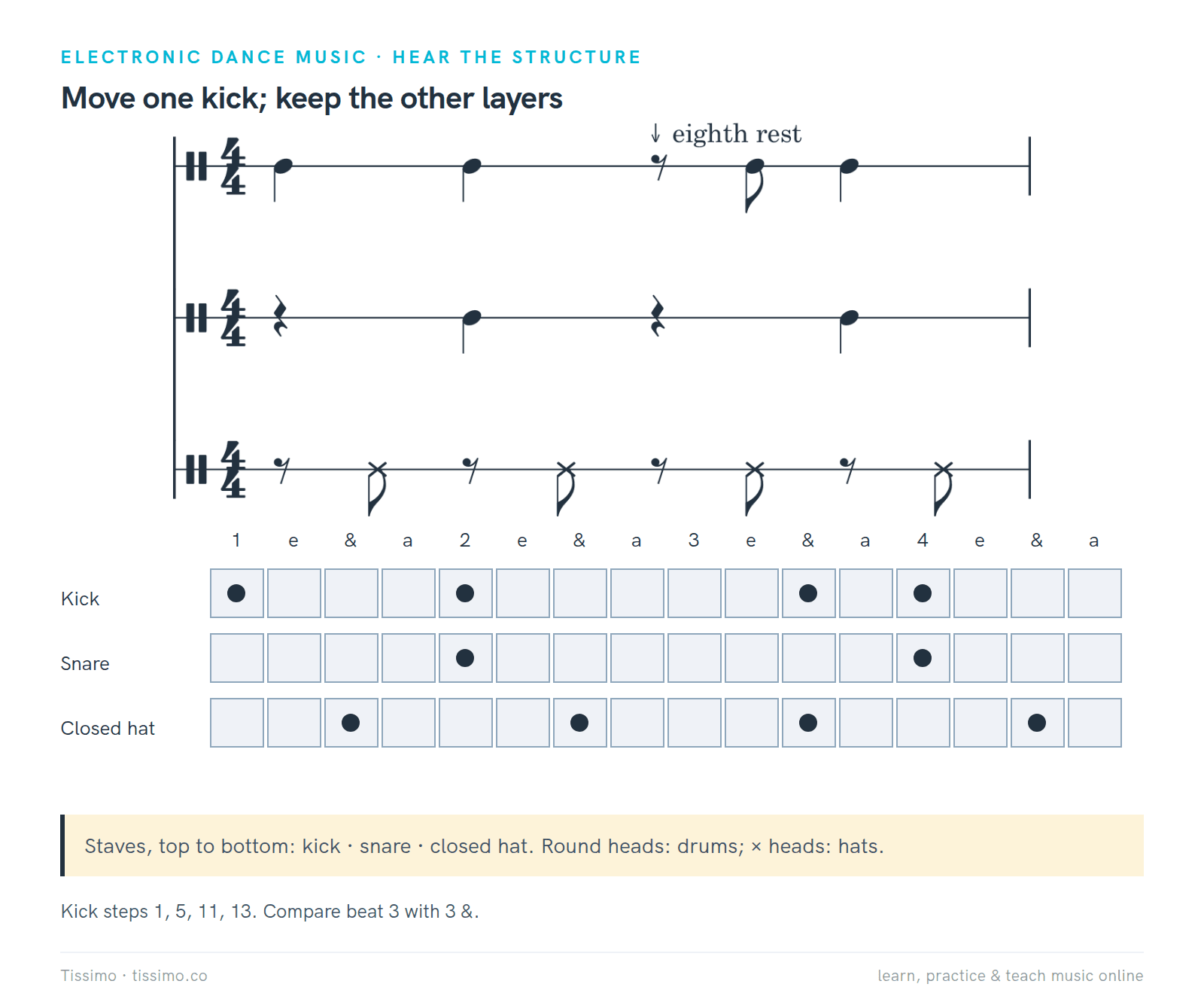
Compare the kick row with the previous figure: only its third attack moves. Beat 3 contains an eighth rest followed by the kick on “&”; beat 4 returns to a quarter-note kick. Keep saying every numbered beat through the gap. The unaltered snare and hats provide reference points for hearing precisely which event shifted.
Syncopation develops offbeat emphasis, and Write the counts 2 asks you to label note and rest onsets. The Rests introduces quarter, half and whole rests. The small hooked symbol in these drum examples is an eighth rest: count half a quarter-note beat before the next strike.
For one half-time comparison, keep counting quarters at 140 BPM, put the kick on 1 and the snare on 3, and nod on 1 and 3. The snare now arrives on every second nod. This is one common dubstep starting pattern, not a rule for every track. Roland’s demonstration provides the starting point.

Keep the quarter-note tempo at 140 in both patterns. The kick stays on beat 1, while the snare changes from beats 2 and 4 in the reference to beat 3 in the half-time example. Nod on 1 and 3: the half-time snare lands on every second nod. The two patterns omit hats so you can isolate the backbeat change; neither is a complete genre recipe.
Keep these examples straight, with equal subdivisions. For a separate long–short comparison, use Swing Eighths, then test your ear with Ear Training: Swing or Straight?. Swing and syncopation describe different timing features; an offbeat attack need not be delayed.

Print Drum Patterns: Sixteen Steps, Four Beats to compare the base pattern and changed kick. Its selected hat move takes step 15 to step 16, changing “4 &” to “4 a.” Try that move while keeping all four original kicks. The separate blank move invites your own answer; it is not another fixed genre pattern.
BPM gives a clock, not a style
BPM means beats per minute. With a steady quarter-note pulse, divide 60,000 milliseconds by the BPM to find the duration of one quarter-note beat. At 120 BPM, a quarter lasts 500 ms, an eighth 250 ms, a sixteenth 125 ms and a four-beat bar 2,000 ms. Tempo & the Metronome supplies the pulse practice behind those numbers.
Tempo Math: Beats, Bars and Delay Times gives a worked row, twenty table cells at four tempos, and questions that work backward from milliseconds. For example, an eighth lasting 250 ms implies a 500-ms quarter: 60,000 divided by 500 returns 120 BPM.
A dotted eighth lasts three sixteenths: 375 ms here. The Dotted Eighth + Sixteenth pairs that duration with the remaining sixteenth. Three eighth-note triplets divide one quarter-note beat into three equal parts instead; their spacing differs from the dotted-eighth–sixteenth pair.

The upper C marks an echo position rather than another beat. In the first row it follows each lower C by an eighth; in the second it follows by a dotted eighth. Different pitches make the two roles easy to track. These written note pairs demonstrate start times, not a delay device’s feedback, decay, stereo behavior or exact audible tail.
Use the timing arithmetic to predict a change before touching an effect. At 100 BPM a quarter lasts 600 ms, so an eighth takes 300 ms. At 150 BPM a quarter lasts 400 ms; three quarters of that beat also take 300 ms. The same millisecond value can therefore represent an eighth at one tempo and a dotted eighth at another. The rhythm is the relationship to the pulse, not the raw number on a control. State both the tempo and the musical duration when you describe your echo choice.
Return to 120 quarter-note BPM and count ‘1 e & a’: those positions occur 0, 125, 250 and 375 ms after the beat begins. Ableton’s Delay manual distinguishes tempo-synced divisions from milliseconds. If you enter a fixed time, recalculate when tempo changes; a synced musical value follows the clock.
Grow one bar into an eight-bar idea
Add an original bass pattern: A on beat 1, rest on 2, E on 3, rest on 4. Repeat it. This is an ostinato, a returning pattern. The rests leave room to hear other attacks instead of filling every subdivision with bass.

Play A2 and E3 in each bar, releasing for the written quarter rests. The scale-degree labels describe the notes relative to A, not finger numbers. Both bars contain the same four-beat pattern, so the repeat is audible without a repeat sign. The separate whole-note chord is A3–C4–E4; hold it for four beats as a middle layer. Try tapping the snare’s 2 and 4 while another player supplies the bass attacks on 1 and 3.
Above it, play C5–rest–E5–G5 in quarter-note values for bars 1–3. In bar 4, replace the final G5 with A5. Motif and sequence gives vocabulary for recurring ideas. Here the fourth bar is a pitch variation; the whole shape has not shifted to a new starting note as a sequence.

Three statements establish C5–rest–E5–G5; the fourth bar changes its final note to A5. Keep the rest on beat 2 audible rather than stretching C across it. In A natural minor, C, E, G and A are scale degrees 3, 5, 7 and 1. Those degree labels describe pitch relationships; they do not declare that every accompanying chord must change.
For the map’s chord layer, play A3–C4–E4 together and hold for one four-beat bar. This A-minor triad puts a minor third, three half steps, between A and C, then a major third, four half steps, between C and E. Reattack it at each bar where the chord lane is active. You can arrange the whole sketch with this single harmony; changing texture does not require a new chord progression. The lower A in the bass reinforces the same home note.
A layer means a distinct musical part: drums, bass, chords or lead, for example. Texture compares ways parts combine. Try removing the lead while keeping bass and drums; then remove bass instead. The same missing number of parts can produce very different effects because their jobs differ.
For a separate eight-bar exercise, return to C5–rest–E5–G5 without the fourth-bar pitch change. Play it in bars 1–7, then replace G5 on beat 4 of bar 8 with G5–A5 eighths. That small fill marks an approaching boundary. Phrase and period offers a classical comparison, but eight bars alone do not establish a classical period or a particular cadence.

Play the example labeled ‘Bars 1–7: repeat’ seven times, then the example labeled ‘Bar 8: one change’ once. Its two final eighths begin on 4 and “4 &,” adding one attack while preserving the four-beat total. Start the original motif again at the next 1. The printed fill marks a boundary by changing rhythm and pitch, without requiring a faster tempo.
Breakdown, build and drop describe functions
A breakdown thins or interrupts the established texture. A build creates expectation through developing activity; a drop delivers a salient arrival. Dennis DeSantis’ Dramatic Arc discusses increased density at a climax but also notes that minimal techno and dub can organize tension differently. Not every dance track needs a dramatic build-and-drop design.
For bars 33–36, repeat the original C5–rest–E5–G5 motif. In 37–38, play G5 eighths; in 39, play G5 sixteenths. In 40, play twelve G5 sixteenths over beats 1–3 and rest the lead on beat 4. Keep the chord layer and tempo unchanged. Compare that version with eight unchanged motif bars. This is one exercise, not required EDM form.
Keep counting through the lead rest while the chord continues. At the next bar, choose either the familiar high motif with returning kick and bass, or one lower sustained note with the kick. Compare expectation and arrival at the same listening level.

Lead parts only: bars 33–36 retain the earlier motif, then the displayed rhythmic stages increase the attack rate through bar 39. Bar 40 has twelve lead attacks and a one-beat lead rest before either three attacks in Drop A or one in Drop B. The chord sustains through the lead rest. Add kick and bass beneath A, or kick beneath B, as the labels suggest. The lower C4 starts nineteen half steps below the build’s repeated G5, making a pronounced register change. No crescendo or master-volume increase is specified.
The 64-bar map below follows Drop A; Drop B is a separate comparison. Drop B has fewer lead notes, yet the return of the kick after its absence during the build can make it feel decisive. Treat that as a listening experiment, not a guarantee. The Dynamic Ladder teaches relative playing levels; density, register and sound color give you additional contrasts beyond playing louder.

An eight-bar build develops in stages: four motif bars, two eighth-note bars, one sixteenth-note bar and one bar with a final lead rest. Keep the chord layer active and compare this version with eight unchanged motif bars. Count the lead’s attacks separately from the number of active layers; no master-volume increase is required.
Give every entrance an address in a 64-bar map
The Arrange a Dance Track in Eight-Bar Blocks exercise supplies one original map: intro 8 bars, groove 16, breakdown 8, build 8, drop 16, outro 8. These choices total 64 bars. Musical form extends the section vocabulary; names describe each section’s job here, not a compulsory EDM formula.
This four-lane sketch uses kick, bass, chord and lead. Use the base pattern’s four quarter-note kicks whenever the kick lane is active. Leave the earlier snare and hat parts out while following its lane states. The full drum groove remains a separate coordination exercise; you can give snare and hats their own lanes in a later arrangement.

Read the lanes vertically at each boundary. Kick starts alone, bass and chords join at 9, and lead joins at 17. Kick and bass leave at 25; lead returns at 33. All four parts are active at 41, and the outro at 57 retains kick only. “Active” means the part plays its pattern, not that it sustains without rests.
Count inclusively: bars 9–24 contain 16 bars because 24 minus 9 plus 1 equals 16. The breakdown is 25–32, build 33–40, drop 41–56 and outro 57–64. Boundary 65 lies after the last bar. At 120 quarter-note BPM, 256 beats occupy 128 seconds before any sound decay.
The worksheet’s build has chords and lead active while kick and bass remain absent. Use the worked trajectory above for those bars; it develops an active part without changing the lane states. The thirty-two-bar bracket groups existing time rather than adding another section. The answer key separates fixed arithmetic from creative layer choices.

Use Arrange a Dance Track in Eight-Bar Blocks to fill the bar ranges, then name one audible change at each listed boundary. Its short listening comparisons demonstrate the final-bar fill; its longer schematic demonstrates entrances and exits with simple teaching sounds. The map is a complete planning example, while the seven creative responses can differ from its model.
DeSantis’ subtractive arranging method offers another way to begin: lay out the available material, then remove parts. Try it on this map. Keep the drop’s complete combination as your reference and decide which ingredients earlier sections should withhold.
Take the sketch from your instrument to a track
For a separate groove exercise, tap kick and snare with a partner while one of you sings the motif. Alone, record the bass pattern, then play the lead over it. Count eight bars, use the fill once, and check the next entrance. Ear Training: Rhythm Dictation offers shorter clap-back and notation tasks if locating attacks by ear needs work.

One eight-bar task, with a clearly placed destination. The fill occupies the final bar and the kick returns at the following bar’s first beat. Withdraw the kick from bar 5 through bar 8 while the motif continues, then restore it on the following 1. Count all thirty-two quarter-note beats. At the suggested tempo those eight bars take sixteen seconds; take a slower practice tempo whenever coordination obscures the planned boundary.
After trying this fixed version, choose another layer to remove and restore. If entrances fail to meet, check the bar length and whether your fill replaced time rather than adding a beat. Listen with just kick and lead, then restore bass and chords individually to locate the problem.
Choose a recording from an artist’s official page or licensed streaming service. Count through one transition and write what changed, without copying its notes: kick leaves, chord remains, lead rises, or texture becomes sparse. If the boundary surprises you, replay the approach and distinguish an actual bar change from your own uncertain counting.
For software execution, our home-production guide covers the broader workflow, and Ableton for beginners demonstrates entering a beat. Arrange your original parts along a timeline, using this map as a starting constraint. For verse/chorus comparisons, consult song structure.
Play your transition once without stopping, then explain its musical change in one sentence. A Tissimo piano teacher can help you keep the pulse through the rests and coordinate the bass with the returning motif in a live lesson.
Free worksheets for this lesson
- Drum Patterns: Sixteen Steps, Four Beats — compare grids, percussion notation and independent layers.
- Tempo Math: Beats, Bars and Delay Times — calculate durations and work backward to BPM.
- Arrange a Dance Track in Eight-Bar Blocks — count section ranges and plan seven layer changes.
- The Sixteenth Note — divide each quarter beat into four.
- The Rests — count written silence.
- Time Signatures I: Simple Time — compare simple meters.
- Tempo & the Metronome — establish a steady practice pulse.
- Syncopation — hear emphasis between beats.
- The Dotted Eighth + Sixteenth — compare even and three-to-one divisions.
- Triplets — divide a quarter-note beat into three eighth-note triplets.
- Write the counts 2 — label note and rest onsets.
- Ear Training: Rhythm Dictation — clap back and write rhythms.
- Swing Eighths — compare straight and long–short timing.
- Ear Training: Swing or Straight? — identify the rhythmic feel by ear.
- Motif and sequence — recognize repetition and changed ideas.
- The Ostinato — follow a returning accompaniment pattern.
- Texture — compare relationships between parts.
- Phrase and period — extend your classical phrase vocabulary.
- Musical form — name and compare sections.
- The Dynamic Ladder — practice relative playing levels.
Sources
- House music’s Chicago foundations — WTTW Chicago Stories
- Techno: The Rise of Detroit’s Machine Music — MSU Museum / MSUToday
- Electronic Music Genres — Berklee
- How to produce a drum and bass track — Native Instruments
- Beat and tempo — Ableton Learning Music
- Tempo and genre — Ableton Learning Music
- Delay, Audio Effect Reference — Ableton Live manual
- Dramatic Arc — Dennis DeSantis / Ableton
- Arranging as a Subtractive Process — Dennis DeSantis / Ableton
- Cornelius Harris interview — Detroit Festival of Books
- Creating Beats for Dance Styles — Roland
- Live Instrument Reference — Ableton
Read this article online: https://tissimo.co/articles/electronic-dance-music-explained-styles-beats-build-ups-and-drops




Comments