 Back

How to Start Learning Trombone: Slide Positions, Your First Five Notes and a Daily Plan
The trombone you start on has no keys and no valves: just a slide, your lips and your ears. Your first month is about a steady buzz, a slide hand that moves quickly to the right place, and the habit of listening to whether you landed there. This guide covers the slide, holding the instrument, a first sound, the first five notes of the B♭ major scale, bass clef, slide care and a 20-minute daily plan.
Everything here is for the B♭ tenor trombone played without an F attachment. If yours has a trigger under the left thumb, leave it alone for now.
How the slide makes the notes
Your lips buzz in the mouthpiece; the slide changes the length of the tubing. Yamaha's guide to playing the scale describes seven positions, counted from first position (slide toward you) to seventh (fully extended), with no markings on the slide: players learn them by feel. Wikipedia's trombone article adds the rule that matters most: on the same partial, each position outward is one half step lower.

Seven positions, each a half step lower than the one before. The gaps grow slightly as the slide goes out; you find each position by ear, not by a mark.
The positions are not evenly spaced. Brian Weidner's open textbook Brass Techniques and Pedagogy gives, in its trombone chapter, about 3 inches from first to second position, growing to just over 4 from sixth to seventh, and notes that the exact spot shifts a little with the partial. So trombonists listen constantly and nudge the slide until the note is in tune.
One position, several notes
The slide sets the tube length; your air and lips choose which note it gives you. Yamaha shows several notes from first position alone: the faster your lips vibrate, the higher the note. Each available note is called a partial.

Three notes, one slide position. Air and lips choose between them.
Wikipedia lists the first-position partials as B♭2, F3, B♭3, D4 and F4, counting the very low pedal B♭1 as partial 1, as our article on the harmonic series does. So a slide number alone doesn't name the note: first position can be B♭2 or F3, and your ear tells you which.
Holding the trombone
Assemble with care: the slide is the part to protect. Hold the slide upright by its brace in your right hand, rubber tip on the floor, slide lock closed. With your left hand, set the bell section onto the receiver on the longer side of the slide, so that bell and slide meet at slightly less than a right angle, and tighten the bell lock by hand only. Yamaha adds: check the slide lock before you join the parts, and put the mouthpiece in with a gentle twist.

The left hand carries the trombone; the right hand only guides the slide. Not to scale.
- Left hand carries everything. Weidner's grip: the thumb and index finger form an "L"; the thumb wraps under the bell tubing, the index finger rests across the mouthpiece brace pointing toward the mouthpiece, and the other three fingers wrap around the slide tubing just below it.
- Right hand guides. Hold the slide brace between the fingertips of your thumb, index and middle finger; the other two fingers curl into your palm.
- Stand or sit tall. Don't slump to the left or rest the bell section on your shoulder.
Avoid a fist around the brace, a common beginner fault: it locks the wrist, and the wrist leads the slide. The elbow joins in for bigger moves; the shoulder helps only for sixth and seventh. Unlock the slide only when you are ready to play, and keep your right hand on the brace from then on: Yamaha's guide warns that nothing else holds the outer slide on, so it can drop to the floor under its own weight.
Buzz first, then your first note
Start every session with air. Sitting tall, breathe in through your mouth for four counts and out for four, with no pause in between and without lifting your shoulders. Weidner opens every practice session this way.
The sound itself starts with your lips. Weidner's first-sound steps, on the mouthpiece alone:
- Say "hmmmmpf," closing your lips only until they touch.
- Hold the mouthpiece by its shank between thumb and index finger and set it gently on the center of your lips.
- Breathe in fully through your mouth.
- Blow a steady, full stream of air, as if saying "pffff."
Your embouchure, the setting of your lips and jaw, is in Weidner's words a flat line: neither smile nor frown, teeth slightly apart, corners firm, center soft. For trombone he centers the mouthpiece with roughly half on each lip, though many professionals use about two-thirds top lip. Yamaha adds: don't puff out your cheeks.
Set the mouthpiece on your lips; don't push it into them.
Teachers differ on how much mouthpiece-only buzzing to do, particularly on the larger brass instruments, Weidner notes; he favors it, and your teacher will decide. His starter is "4 on, 4 off": buzz a comfortable pitch for four counts, mouthpiece off for four, repeat.
Now put the mouthpiece in the trombone, keep the slide closed and blow the same buzz for four slow counts. A piano or tuner tells you which partial you found, most likely B♭2 or F3; either is a fine first note. Then play both as long tones: held notes at a soft, steady volume, with rest between.
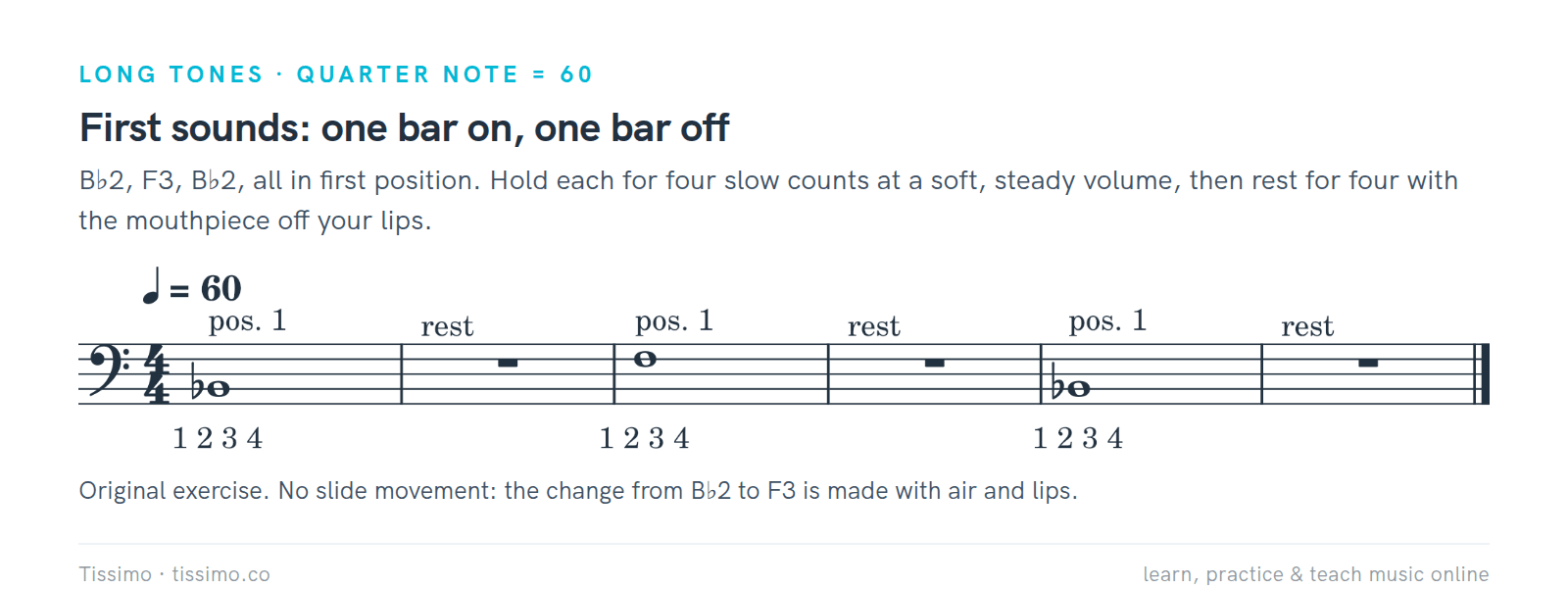
One bar on, one bar off, all in first position. Only your air and lips change.
Each long tone is a whole note, four counts held. To move from B♭2 up to F3, Yamaha's guide pairs low, middle and high notes with the syllables "toh," "tay" and "tee." More mouthpiece pressure is not the way up.
Your first five notes: B♭, C, D, E♭ and F
The B♭ major scale starts B♭2, C3, D3, E♭3, F3. The Yamaha trombone position chart and Weidner's Trombone Position Chart agree on every one.
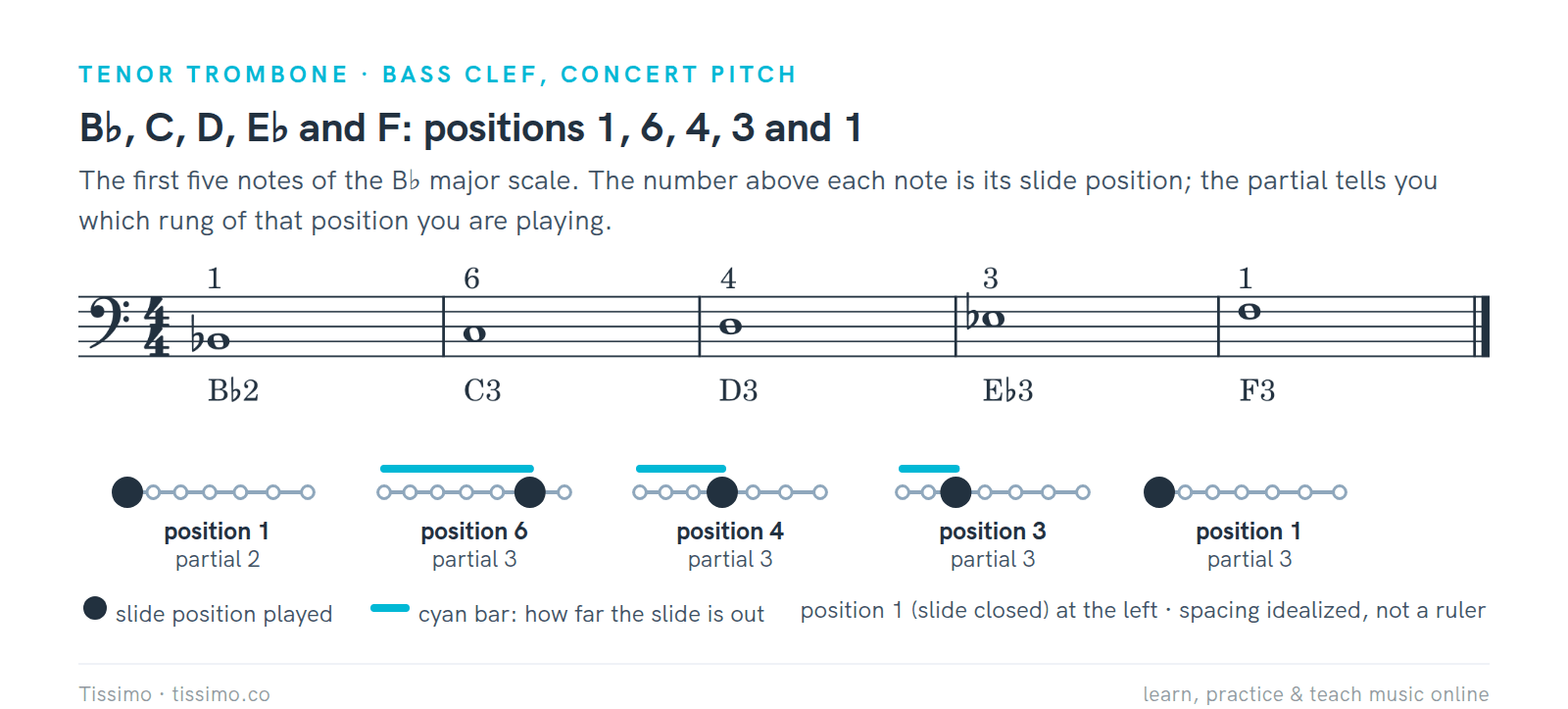
B♭2 in 1, C3 in 6, D3 in 4, E♭3 in 3, F3 in 1. Only B♭ sits on partial 2; the other four share partial 3.
- B♭2, on the second line of the bass staff: first position, partial 2.
- C3, in the second space: sixth position, partial 3.
- D3, on the middle line: fourth position.
- E♭3, in the third space: third position.
- F3, on the fourth line, the line between the bass clef's two dots: first position again.
The grid shows why. Partial 3 starts on F3 in first position and drops a half step per position: E3, E♭3, D3, D♭3, C3.

The five notes on the partial grid. F3 also appears on partial 4 in sixth position, an alternate you'll meet later.
Yamaha's chart lists that sixth-position F3 as an alternate, and David Mathie's guide to alternate positions explains why: middle F is the third partial of first position and the fourth of sixth. For now, play F3 in first.
Sixth position is a long way out, and beginners often can't reach the outer positions yet. If C3 is a stretch, tell your teacher.
To find a new position the first time, sound the note on a piano or a tuner, then move the slide slowly out from first position until your note matches it. Do that a few times and your arm starts to remember the spot. The Yamaha chart draws the slide for every note, which gives you a first guess. Weidner advises against feeling for the bell with your fingers to place third and fourth position: it gives a false sense of confidence.
These five notes leave out the rest of the second partial, which runs from B♭2 in first position down to E2 in seventh. Our slide positions article maps that register one half step at a time, and Trombone: One Register, Seven Positions puts it on one page.

The second-partial map: B♭2 = 1 down to E2 = 7, with order cards that show sequence, not distance.
Slide Route Detective is the written check: name positions, find two wrong labels, and name the next note after each rest.
Move the slide quickly, and tongue every note
Weidner's rule: always move the slide quickly, or you'll hear a glissando between notes. Start with one move at a time, with a bar of rest after each: the slide stays where it is, and you name the next position before you play.

Four moves, each followed by a rest. The first one, 1 to 6, is the longest.
Tongue every note at first. Weidner's brass tongue touches the roof of the mouth just behind the top teeth with a "tu" or "du," then returns to a relaxed "ah": it interrupts the air without stopping it. The figures here write that start as "tah." Use a metronome at 60 (Tempo & the Metronome explains the marking and the slow ramp).
Read it in bass clef, at concert pitch
Concert band trombone parts are nearly always in bass clef, and band and orchestra parts are at concert pitch: the note on the page is the note that sounds. Yamaha's note on trombone notation explains that although the fundamental is B♭, the music is written in C.
Unlike a B♭ trumpet player, you don't transpose. If the bass clef is new, The Bass Clef & the Grand Staff gives you the line notes G B D F A and the spaces A C E G, Name the notes: bass clef drills 25 of them, and our guide to the bass clef goes further.
Music in B♭ major uses a key signature of two flats, B♭ and E♭, after the clef on every line: every B and E is flat unless a natural sign says otherwise. That is why the scale below has no flat signs on its notes.
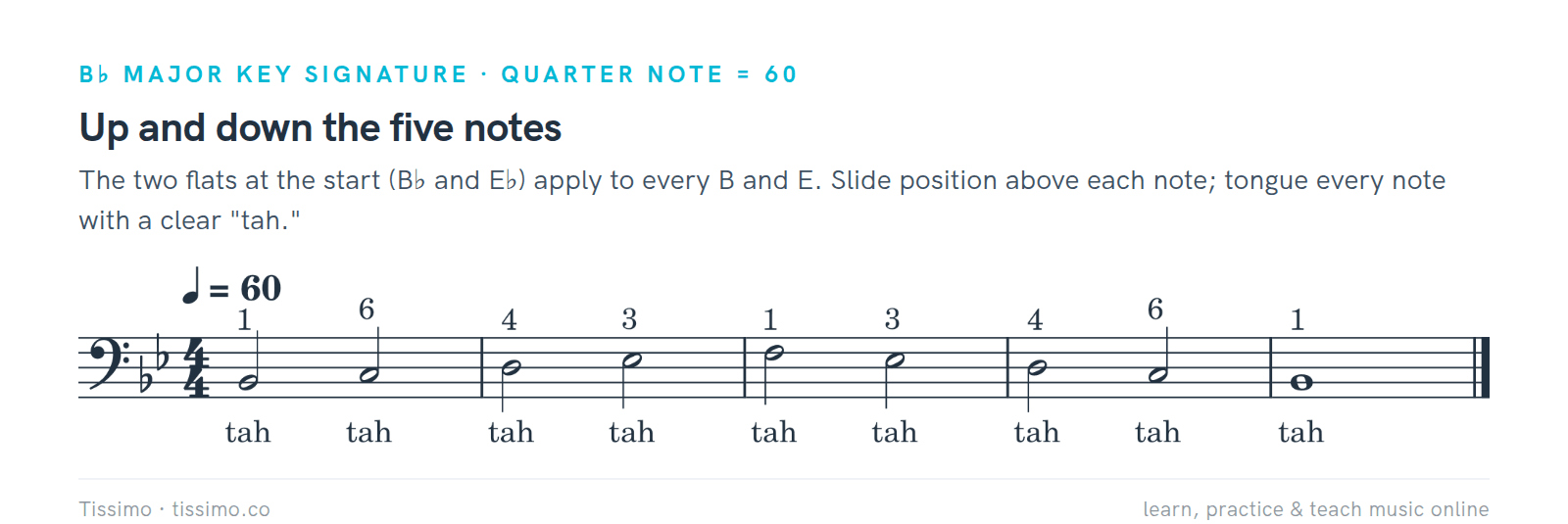
Up and down the five notes. Every note is tongued with "tah" and every change is a slide move.
One exception to concert pitch: in the British brass-band tradition, Wikipedia notes, tenor trombones read B♭ treble-clef parts that sound a major ninth lower than written, so a written middle C sounds B♭2. The ConductIT conductors' course lists the same interval for B♭ trombone in treble clef. Your positions don't change; only the page does.

The same five sounds written two ways. A brass-band part shows them a major ninth higher, in treble clef.
Written & concert pitch practices the idea with B♭ clarinet, horn and alto sax, and our guide to transposing instruments explains why the system exists.
Legato: a light tongue while the slide moves
Legato, smooth and connected, is harder on a slide. C, D, E♭ and F share partial 3, so if you blow without tonguing, the pitch glides along with the slide. Weidner's fix is a very light "lah": the tongue barely interrupts the air while the slide moves as fast as it can.
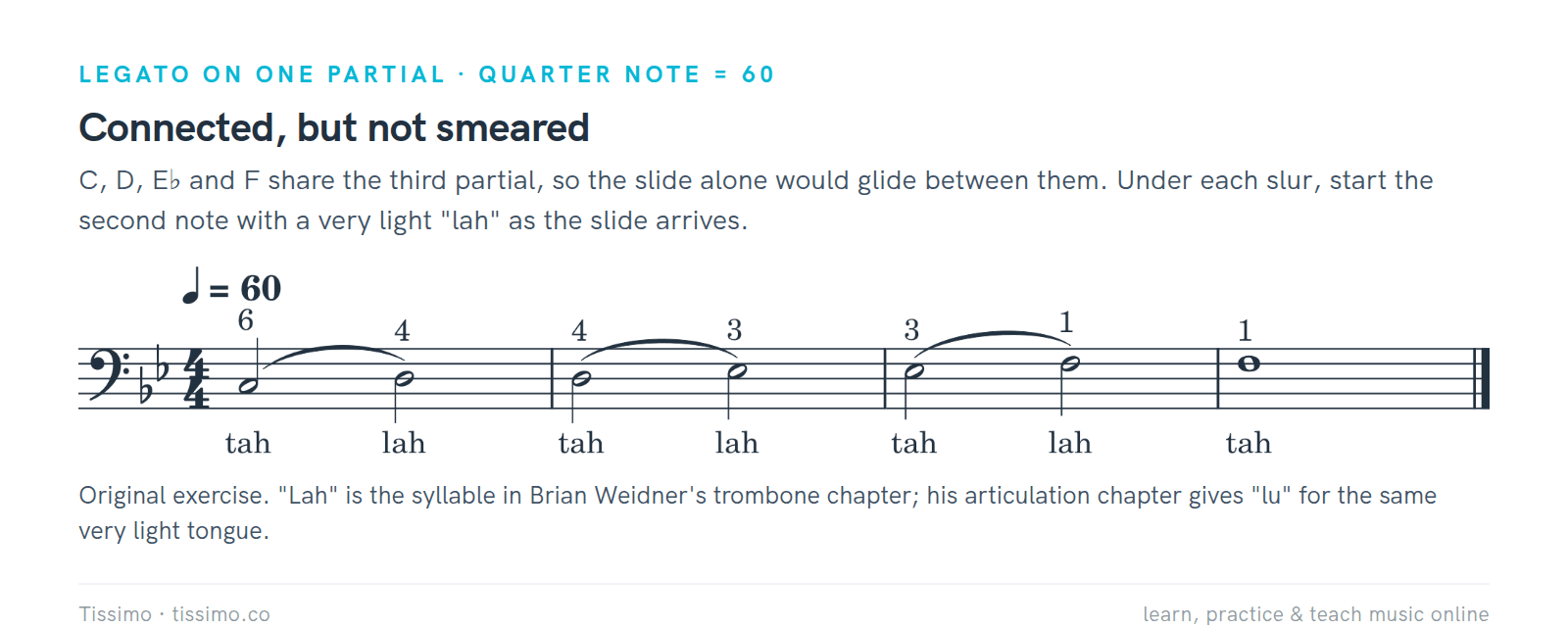
Under each slur, a light "lah" starts the second note as the slide arrives. Same partial, so the tongue does the separating.
Our article on trombone legato tonguing works through this on the second partial, with Connect the Notes, Clear the Change as its four-bar plan and Mark the New Arrival as the check: late slide or early tongue?
Your first tune
Here is an original eight-bar tune on the five notes, in quarter, half and whole notes (The quarter note and The half note count out the one-beat and two-beat values). Read the positions first and find the three big moves: 1 to 6 in bar 1, 1 to 6 from bar 6 into bar 7, and 6 back to 1 for the last note.

An original tune on five notes. Breathe at the comma after bar 4.
Play it tongued, first at 60 and then at the marked quarter note = 72. When a bar trips you, use the fix-it loop from How to practice: stop, find the exact notes, play them slowly, and get three clean in a row.
Twenty minutes a day, with rest built in
Range grows slowly. Weidner says beginning trombonists often have a range of around an octave, and warns against rushing higher notes before they come without pressure. So keep the plan short, and keep it the same every day.

The same five blocks every day. The minutes are a suggestion; the rest rule is the part to keep.
Start with 3 minutes of breathing and mouthpiece buzzing, four counts on and four off. Then play 5 minutes of long tones on B♭2 and F3 with the metronome at 60, 4 minutes of the four slide moves, and 5 minutes on the scale and the tune, looping any bar that trips you. When the tongued scale is easy, add the legato pairs to that block. Finish with 3 minutes of care: water out, slide locked, both sections in the case.
The rest rule is Weidner's: as much time off the face as on. When the buzz goes fuzzy, stop for the day; pressing harder is how bad habits start. Our article on building a practice routine goes deeper.
Keep the slide clean and moving
Weidner warns that even small dents can make a slide unusable, and the Ames 5th Grade Band care page adds two rules: carry the trombone upright and close to your body, and never lean it against a music stand.

A simple schedule. Sources differ on how often to re-lubricate the slide; follow your teacher where they differ.
- Before playing. Yamaha's daily care page: wipe the inner slide, put a very small amount of slide cream or slide oil on its slightly thicker end sections, mist with water if you use cream, and work the slide back and forth. Never use tuning-slide grease on the main slide.
- After playing. Open the water key and blow the water out. Lock the slide, take the mouthpiece out and case both sections. A stuck mouthpiece goes to your band teacher (Ames).
- Weekly. Wash the mouthpiece with warm water, soap and a brush. Ames re-lubricates the slide weekly; so does Weidner's rule of thumb, sooner if it drags.
- Monthly. Ames greases the tuning slide if it is stiff; Yamaha cleans the inside with a flexible brush and brass soap.
Where a teacher helps most
Three things are hard to judge alone: whether you are in tune in each position, whether air or mouthpiece pressure is getting you up to F, and whether your slide arrives on time. A Tissimo trombone teacher can hear all three in a live lesson and fix your setup before habits form.
Free worksheets for this lesson
- Trombone: One Register, Seven Positions — the second partial, B♭2 down to E2
- Slide Route Detective — positions, wrong labels and reading through rests
- Connect the Notes, Clear the Change — light legato tongue on same-partial pairs
- Mark the New Arrival — aligned, late slide or early tongue?
- The Bass Clef & the Grand Staff — the F clef and its line and space names
- Name the notes: bass clef — 25 notes on and near the bass staff
- Written & concert pitch — converting both ways (intermediate)
- Tempo & the Metronome — metronome marks and the slow ramp
- The whole note — four counts of steady sound
- The half note — two beats, held through
- The quarter note — one beat, the bar and 4/4
- How to practice — the fix-it loop
Sources
- How to play the scale — Yamaha Musical Instrument Guide
- Trombone fingering chart (PDF) — Yamaha Musical Instrument Guide
- How to play the trombone — Yamaha Musical Instrument Guide
- The trombone: the instrument that extends and retracts — Yamaha Musical Instrument Guide
- For trombones, why does sheet music notation differ from the fundamental tone of the instrument? — Yamaha Musical Instrument Guide
- Care and maintenance: what do I need to do daily? — Yamaha Musical Instrument Guide
- Brass Techniques and Pedagogy, 2nd edition: The Trombone; Getting Started with Posture and Embouchure; Tone Production Fundamentals on the Mouthpiece; Articulation on Brass Instruments; Brass Acoustics; Instrument Care — Brian N. Weidner (PALNI Open Press)
- Trombone Position Chart (PDF) — Brian N. Weidner
- Trombone — Wikipedia
- Alternate Positions (And How to Use Them) — David Mathie, Online Trombone Journal
- Transposing instruments (PDF) — ConductIT MOOC
- Instrument Care: Trombone — Ames 5th Grade Band
Read this article online: https://tissimo.co/articles/how-to-start-learning-trombone-slide-positions-and-first-notes




Comments