 Back

Keep the Beat When the Metronome Goes Silent
Clap four steady beats with a metronome. Keep clapping when it goes quiet for one planned bar. On the next downbeat, the click returns: does your clap arrive before it, together with it, or after it?
That is the whole task. You will begin with four audible bars and one silent bar in straight 4/4, keep the same quarter-note pulse, and learn to judge the return. You need no fast passage or new equipment. Start by clapping; later, put the same test under an easy pattern on your instrument.
1. Hear the click, then carry the pulse
A continuous click supplies a reference on every beat. During a gap, you keep producing those beats without that sound. “Internal pulse” here means the beat you continue to feel and count; it is a practical description, not a measurement of a separate clock in your brain.
Set a quarter-note click to 72 beats per minute. Clap once per click and say “1, 2, 3, 4.” Begin again at 1 without making a longer space after 4. Tempo & the Metronome introduces continuous-click practice; use that first if matching each click still takes your full attention.
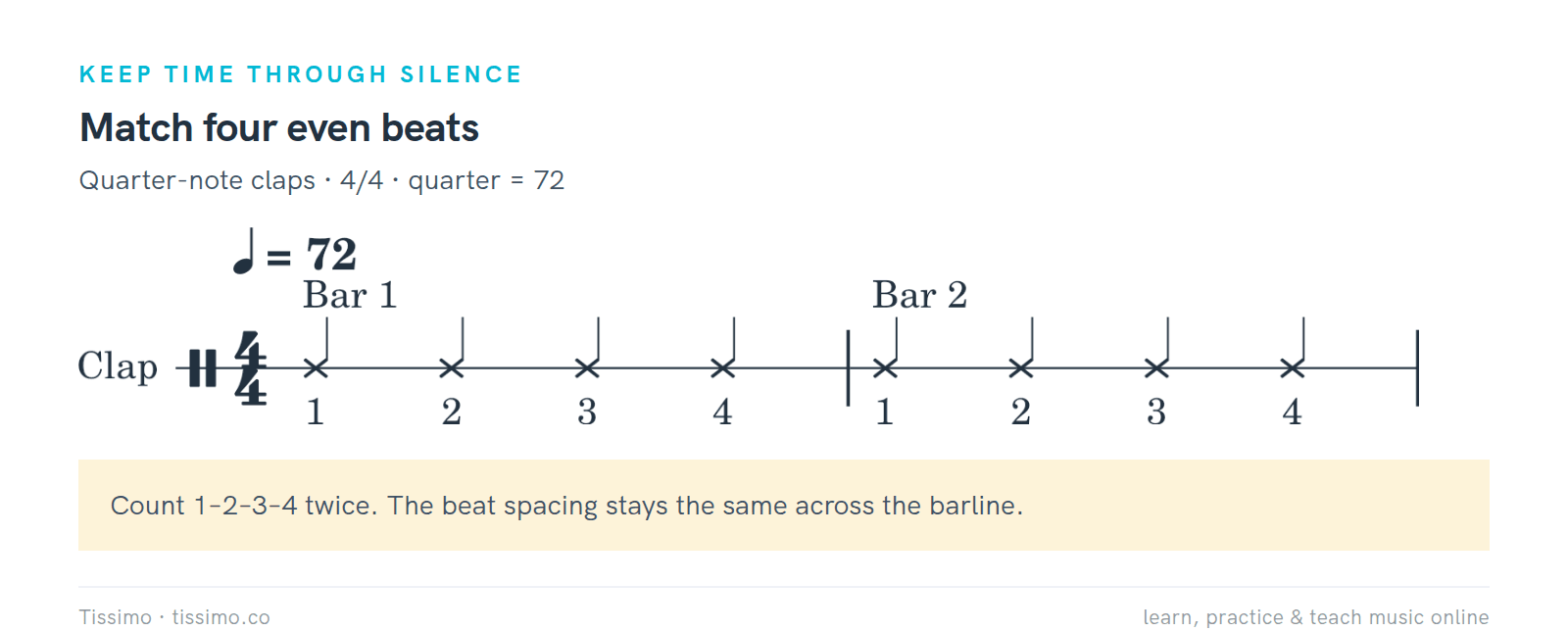
Clap once on each quarter beat, counting 1–2–3–4 in both bars. Keep the interval from 4 to the next 1 equal to the other beat intervals.
Keep the claps light enough that you can still hear the reference. If you lose the count, stop, listen to a complete bar, and enter on the following 1. With an adjustable metronome, choose a comfortable speed if 72 feels awkward and keep it unchanged between comparisons. The companion worksheet recordings use 72 BPM; settle into that pulse afresh before using them.
Tempo is the rate of the pulse, as The Open University explains. Here, 72 means 72 quarter beats in a minute. It does not mean 72 bars or 72 notes of any duration. Each beat is about 0.83 seconds; four beats fill about 3.33 seconds.
Try this readiness check before moving on. Listen for one bar, clap for two bars, then listen for one more bar while silently counting. Can you keep the numbers going even while your hands stop? Repeat if you lose track of 1. This small check separates hearing a pulse from knowing where you are within its four-beat grouping.
2. Make the silence intentional
Use a prepared gap track or a metronome setting that removes whole bars while its timing continues. Do not press stop and try to restart it yourself on the right beat. That adds another timing task and removes the fixed return you need for comparison.
For a browser option, open Gap Trainer. Set 4/4, 72 BPM, Main beats, straight timing, four click bars and one silent bar. Use a one-bar count-in and check the settings before starting. A finite run can finish after a silent bar without another return; judge only gaps that are followed by an audible return.
Before clapping, listen through one complete gap and its return. Confirm four clicks per audible bar, four audible bars, then one bar without clicks. If the tool shows moving beat lights, look away during the test. Otherwise the display can continue supplying an external reference even while the speaker is quiet.

Hear the quarter pulse, count four beats per bar, then continue the same action through the planned gap.
Give yourself a spoken count-in: “1, 2, 3, 4,” then start practice bar 1 on the next beat. The count-in is outside the numbered practice bars. In the illustrations it is labeled bar 0 solely to make that separation visible.
Open Music Theory’s simple-meter chapter explains the two time-signature numbers. In this 4/4 exercise the upper 4 gives four beats per bar and the lower 4 makes the quarter note the beat unit. Keep those two facts fixed throughout.

Use the first measure to speak the count-in and the second to begin clapping. Bar 0 is an explanatory label, not a universal way of numbering count-ins. The gap schedule starts with practice bar 1 after this setup bar. If a recording already includes its own count-in, follow that introduction rather than adding a second one and shifting every practice-bar number.
Check the sound setup before judging any return. Listen while someone else claps lightly near the speaker, or record a few continuous beats yourself. Both sounds should be audible without either overwhelming the other. If the clap hides the click completely, make it softer and try again. Keep this listening balance for the gap attempt.
If the track stops unexpectedly, treat that as an interrupted attempt. A planned gap has a known length and a scheduled return. Randomly losing playback does not give you that same reference. Restart from the introduction rather than trying to work out a result from an uncertain start.
3. Count four bars on and one bar off
The first cycle is bars 1–5: clicks in bars 1, 2, 3 and 4; no clicks in bar 5. The next audible downbeat is bar 6, beat 1. If the five-bar cycle repeats, bars 6–9 have clicks, bar 10 is silent, and the next return is bar 11.
To track the bars, say “1-2-3-4, 2-2-3-4, 3-2-3-4, 4-2-3-4, 5-2-3-4.” Only the first number names the bar. At the return say “6-2-3-4.” Continue 7–2–3–4, 8–2–3–4 and 9–2–3–4; bar 10 is silent and bar 11 begins with the returning click. Each bar number still occupies only beat 1, even when its name has two syllables. Practice this wording with continuous clicks before using the gap.

Read across the Click lane: four audible bars, one silent bar, then the first bar of the next cycle. Read across the Clap lane: no missing beat at all. The larger first dot identifies each bar’s downbeat. Bar 6 is displayed to show the return; it is not an extra sixth bar inside the five-bar cycle. Continue the same pattern to reach the next silent bar, bar 10.
The Browser Metronome gap lesson also begins with four audible bars and one silent bar. This article keeps that arrangement so you can learn one clear comparison rather than change settings after every attempt.
Keep the Pulse Through Silence pairs the quarter-note clap line with the four-on/one-off timeline. Use it beside the track to identify the gap before you begin. Your part continues; the printed silence applies to the click lane only.

The two parts make different instructions visible at the same time. In bar 5 the upper whole-bar rest removes the click, while the lower part still asks for four claps. At bar 6 beat 1 both parts attack together in the written model. A rest belongs to its own part; it does not automatically silence another player, another track or your continuing count.
At 72, bar 5 begins about 13.33 seconds after practice bar 1 begins. Bar 6 begins about 16.67 seconds after that same starting point. These times exclude the count-in. You need not watch a clock: count four beats in every bar, including the silent one.
Use the handout’s audio in order. Audio 1 establishes the continuous reference; Audio 2 provides the gap clicks. Audio 3 adds a steady higher model sound against the lower click. Hear that demonstration once, then use the click-only version for your own trial. Following the model throughout would give you another audible pulse during the supposedly unsupported bar.
There is a useful distinction between losing the pulse and losing the bar number. If you keep four evenly spaced claps but call the return bar 5, practice naming the bars. If you know it is bar 6 but your last few claps become uneven, keep the numbering and simplify your movement.
4. Keep doing the same thing through the gap
Clap through bar 5 without changing your movement or adding a flourish. Keep speaking the counts if that helps. Listen for the interval from beat 4 to the returning 1: it should feel like any other quarter-beat interval, not a longer wait for permission to continue.
Do not aim your final clap toward a return you can already hear. Keep your next downbeat where your continuing pulse predicts it, then hear how the two sounds meet. For the first attempt, one gap and one return are enough. Stop after the complete returning bar and describe what happened.

Your clap line is unchanged at the gap boundary. The click is absent for bar 5, but your four claps still fill exactly four beats. The next clap is bar 6 beat 1, one quarter beat after bar 5 beat 4. Do not add a fifth beat to the silent bar, repeat beat 4, or stop your hands to wait for the reference to return.
On another attempt, keep speaking through the whole returning bar instead of falling silent at the first click. That gives you a chance to hear whether the reference and your count continue together after the comparison point. Finish the attempt before discussing it; stopping mid-bar makes the next restart harder to organize.
Put it on your instrument
First replace each clap with one easy, repeated note. The C5 below is simply a written example; use a comfortable pitch on your instrument. Keep the same attack pattern, volume and tempo. Leave demanding fingering, leaps and chord changes for another session.

Move the same pulse from clapping to a repeated note. C5 is in the third space of the treble staff, counting spaces from the bottom. Use a comfortable pitch on your own instrument. Make each onset clear enough to compare with a click while keeping the playing easy. The bar numbers still refer to the gap cycle: no click in bar 5, returning click on bar 6 beat 1.
Next try two half notes per bar. Keep counting all four quarters while each note lasts two beats. Your hands now make fewer attacks, but the underlying pulse stays unchanged. If the return becomes hard to hear, return to quarters before adding another difficulty.

Each half note covers two quarter beats: attack on 1, continue through 2, attack on 3, continue through 4. The lower part shows the pulse you count; it need not be an additional audible accompaniment. Hold or let each note last as your instrument allows, without making a new attack on every counted beat. Bar 6 still begins at the same scheduled return.
Musical rests need the same continuing count. Play on beats 1 and 3, rest on 2 and 4, and keep counting. The Rests teaches those written silences. Distinguish a rest in your part from an entire bar muted in the click track: either can happen without stopping time.

Here your instrument is silent on 2 and 4 in both bars, while the silent-click condition lasts for all four beats of bar 5. Keep counting the upper rests at their full one-beat value. The lower line represents that continuous count, not a requirement to sound notes during your written rests. Compare your next played downbeat with the returning click in bar 6.
An optional change is eight even eighth notes in bar 5, followed by quarters in bar 6. Say “1 and 2 and 3 and 4 and.” Put two attacks inside each beat; do not double the click speed. Skip this version if subdivisions distract from the basic gap task.

Fit two even eighth notes inside each quarter beat in bar 5, then return to quarters in bar 6. The lower line shows the unchanged pulse. Keep counting 1-and through 4-and so the final eighth leads to the returning downbeat.
5. Hear early, aligned and late
Use the click as the reference. If your returning clap sounds first, your clap is early. If the click sounds first, your clap is late. If they seem to land together, call the return aligned. Choose ‘unsure’ when you cannot confidently hear the order. The worksheets call an aligned return “together.”

Read left to right as time. The line marks the returning click; the dot marks your clap before, with or after it. The horizontal offsets are schematic, not a calibrated scale.
Try The Click Comes Back: Early, Together or Late? as a listening task before grading your own claps. Hear each model without playing, choose its label, then use the check material. Practicing the comparison separately lets you concentrate on one sound relationship.
The model offsets are teaching examples, not a personal pass mark. A close-sounding return is useful feedback, but one aligned downbeat cannot prove that every interval inside the gap was even. You could rush the beginning and stretch the ending. Listen to the whole silent-bar performance as well as its endpoint.
Compare the clap you counted as bar 6 beat 1, not whichever clap happens to fall nearest the click. If the click returns while you are saying 4 or 2, you have lost your place even if the sounds coincide. Mark that attempt ‘lost count,’ return to continuous clicks, and rebuild the four-beat bars.
Try the deliberately displaced count below with a teacher. Keep the claps together while speaking the two rows separately; then restart both rows together on 1. Listen for the difference between matching an attack and agreeing where the bar begins.

Read each vertical pair before clapping. At the reference 1, the lower row says 4; at reference 2, it says 1; at reference 3, it says 2; at reference 4, it says 3. Every clap can coincide with a click while the lower count places its own 1 one quarter-note beat later than the reference 1. For the first reading, let a partner speak the upper row while you speak the lower row, with both of you making four equal claps. For the second reading, start together and speak 1–2–3–4 in both rows. The change you are checking is agreement about the downbeat, rather than a change in the distance between attacks. In a gap trial, preserve both pieces of information: the continuing beat spacing and your place in the four-beat group. If the returning click meets your spoken 4 as in the first vertical pair, record lost count and reset the grouping with continuous clicks before judging another return.
With the count intact, judge the onset order.

Judge your counted downbeat against the returning click: before is early, together is aligned, after is late. Choose unsure when you cannot hear the order.
Make sure your chosen pattern actually attacks on the returning downbeat. A note sustained across that moment gives you no new onset to compare. For now, keep a fresh note on bar 6 beat 1; save tied entrances and other subtleties for later work.

A tie carries the existing note through the return, so there is no new instrumental onset on bar 6 beat 1. The second line starts a fresh note there, giving you an onset to compare with the click.
The listening exercise has six model items, each with its own count-in and return bar. The higher short sound is the model clap and the lower sound is the click. Write a choice before opening the separate check clip. If you miss an item, replay it listening only for which of those two sounds begins first at the return.
Choose the exercise’s “Live clap trials · four returns” track in the Practice group: it has one count-in, and you keep clapping through the whole track. The silent bars are 5, 10, 15 and 20; the return markers are bars 6, 11, 16 and 21. Continue through each return bar. Record your own labels in the row spaces, including unsure when needed. The printed listening key answers the constructed models; your live attempts use the ear-based rubric.
On your recording, first check the last audible bar. Were your claps already ahead of or behind the clicks? If so, match the continuous click before judging the gap. If the last audible bar matched but the return did not, listen through the silent bar for where the spacing changed.
If you are early, resist making the whole next trial deliberately slow. Reestablish the original pulse with continuous clicks, then try again. If you are late, avoid a compensating sprint. Change one thing at a time: simplify the playing, shorten the practice attempt, or return to continuous clicks.
If you are unsure, listen again without playing along. Leave the label open when you still cannot hear the order, then make a fresh attempt.
6. Add a second silent bar only when ready
Stay with one silent bar until you can keep your place, keep the claps evenly spaced and hear several returns close to the click without a last-moment correction. Three such trials can be a personal checkpoint, not a universal standard. If the result is consistently early or late, keep the shorter gap and work on that pattern before adding another silent bar.
With four audible bars and two silent bars, bars 5 and 6 lose their clicks. Keep eight quarter beats going through that gap. The return moves to bar 7, beat 1. The cycle now lasts six bars; if it repeats, the following return is bar 13.

Adding one silent bar moves the return from bar 6 to bar 7; it does not move the first gap later. Count all four beats of bar 5 and all four of bar 6 before reaching bar 7 beat 1. The final column shows the beginning of the next six-bar cycle. The clap lane contains eight evenly spaced attacks across the two silent bars, with no extra beat between them.
At 72, the two-bar gap lasts about 6.67 seconds. The first return is 20 seconds after practice bar 1 begins, excluding the count-in. Keep the tempo unchanged when lengthening the gap so you can hear what that single change does.

Compare this with the one-bar-gap score: there is now a second whole-bar rest in the Click part, but no rest has been inserted into your clap part. Continue through the barline between the two silent bars exactly as you do between audible bars. The written model meets the return on bar 7 beat 1; if the longer gap becomes confusing, restore the one-bar version.
7. Record a comparison and choose the next attempt
Make a short recording that can hear both the click speaker and your claps. Include the count-in, one complete gap and the returning bar. Listen once for the first returning downbeat, then again for uneven spacing inside the gap. Do not try to judge from a screen cursor alone.
Write the tempo, gap length and what you heard: “72; one silent bar; clap before click,” for example. Add one practical next step: “repeat with claps” or “continuous clicks first.” Avoid turning one result into “I have bad rhythm.” You are describing one attempt under specific conditions.

The minutes total five: one to settle into the click, two to make short gap attempts, one to listen, and one to apply what you heard. Pause or repeat a step when needed. The final minute may use continuous clicks again; a useful session does not have to end with a longer silence. Keep the same tempo and pattern when comparing two attempts so the result is easier to interpret.
Record attempt A with quarter claps, spend a minute matching continuous clicks, then record attempt B with the same gap. Listen without deciding in advance that B must be better.
Write one observation for each attempt rather than a total score. For example: “A: the clap came before the click; B: the return sounded together, but beat 4 hesitated.” That description suggests the next task: keep bar 5 evenly spaced rather than merely trying to land its endpoint. Save a short example to discuss with your teacher.
For example, suppose your claps meet the clicks throughout bar 4, then the space between your third and fourth claps in bar 5 sounds shorter. Your counted 1 arrives before the returning click. Write “early; shortened final interval,” then repeat with spoken counts at the same tempo. If bar 4 was already early, first make a new continuous-click recording; the return alone cannot tell you when the offset began.
Use the comparison below to locate a change before choosing a repair. Follow one row from left to right; compare its last audible bar with its silent bar and return. The two attempts end early for different reasons.

Each four-beat column is one practice bar. The upper Click lane sounds during bar 4, disappears for bar 5 and returns at bar 6; the vertical guides show where its unchanged beat schedule continues during the gap. Read row A first: its claps are already ahead in the last audible bar, and that same offset continues through the silence and the return. Begin its repair with continuous-click matching. Listen for that same order on all four audible beats, rather than correcting only the first clap of the return. Now read row B: its four bar-4 claps meet the guides, and the first three bar-5 claps also keep those positions. The next clap moves left, shortening the interval from bar 5 beat 3 to beat 4; the remaining dots keep that new offset. Begin its repair by repeating the shorter gap with even spacing through the final silent-bar beats. Both rows reach bar 6 before the returning click, but their histories differ. At bar 6 beat 1, both lower dots lie the same distance left of the guide. Cover the bar-4 and bar-5 columns: the two returns look identical. Uncover those columns to locate the earlier match or mismatch before choosing which attempt to repeat. Keep the reference lane unchanged when comparing the rows. To compare a recording with these models, listen to bar 4 first, then bar 5, then the returning downbeat. The point positions are constructed examples on a common time grid, not a tolerance or a score for your performance.
Research provides context, not a promise for this routine. Matthews and colleagues’ study included a task in which participants tapped with a metronome and continued at the same rate after it stopped. That laboratory task is related to this practice idea; it does not validate our five-minute plan or make one return a diagnostic test.
For recordings, keep the judgment ear-based. The REPP research paper explains why hardware and software timing complicate online synchronization measurement. An ordinary recording is useful for listening, but do not turn a visible waveform offset into a calibrated score for your own playing.
If maintaining the pulse is hard, simplify to claps and restore continuous clicks. If hearing the difference is hard, listen without clapping. Carnegie Hall’s pulse activities use clapping and other body percussion to explore steady beat; you can return to those basic actions without changing your musical goal.
For a separate challenge, Ear Training: Rhythm Dictation asks you to clap back, complete and write rhythms. Use it when you want to identify rhythmic content. Here, keep the rhythm simple enough that your attention stays on carrying the same pulse through silence.
A Tissimo teacher can listen to the return and help choose an easy instrumental pattern. Bring one short recording and one specific question, such as whether your last silent-bar beat stretched before the click came back.
Free worksheets for this lesson
- Keep the Pulse Through Silence — quarter-note claps and the four-on/one-off click timeline.
- The Click Comes Back: Early, Together or Late? — listen to model returns and compare your own trials.
- Tempo & the Metronome — establish a continuous-click reference before adding gaps.
- The Rests — count written silences while the beat continues.
- Ear Training: Rhythm Dictation — practice hearing, clapping and writing rhythmic patterns.
Sources
- Gap metronome practice — Browser Metronome
- From pulse to tempo — The Open University
- Simple Meter and Time Signatures — Open Music Theory
- Explore Pulse — Carnegie Hall
- The Impact of Instrument-Specific Musical Training on Rhythm Perception and Production — Matthews and colleagues
- REPP: A robust cross-platform solution for online sensorimotor synchronization experiments — Anglada-Tort and colleagues
Read this article online: https://tissimo.co/articles/silent-metronome-bars-keep-time




Comments