 Back

Harmonica for Beginners: Holes, Single Notes and First Melodies
A ten-hole harmonica in C has 20 reeds but only 19 different notes, and it plays a chord the moment you breathe through it. Getting one clear note out of it is the first real skill. This guide covers the layout, the hold, reading hole numbers with blow and draw signs, a single note with the pucker, the C major scale in holes 4 to 7, three short original tunes, and two techniques to know about but not rush: bending and second position.
Everything here assumes a standard ten-hole diatonic harmonica in C, often sold as a "blues harp," with its key marked on it. Chromatic, tremolo, low-tuned (such as Low C) and specially tuned harmonicas are laid out or pitched differently.
How a C harmonica is laid out
Each hole leads into a channel with two reeds: one sounds when you breathe out, called blow, and one when you breathe in, called draw. As Steve Baker explains for HOHNER, the two are tuned to different pitches. So a hole number alone is half an instruction: hole 4 gives C5 when you blow and D5 when you draw.
The standard arrangement of those notes is called Richter tuning. The blow notes are C, E and G repeated up the instrument; the draw notes are D, G, B, D, F, A, B, D, F, A. The HOHNER catalog's tuning chart puts hole 1 blow on C4, middle C, so the blow notes climb three octaves, C4 to C7. The map below was computed from that layout and checked against the HOHNER chart and the Lee Oskar key-of-C chart.

The full map of a C harmonica. You will use holes 4 to 7 most in this guide; the low holes are mainly for chords.
Three details in that map explain most of what follows:
- 2 draw and 3 blow are the same note, G4. HOHNER's FAQ explains why: on a C harmonica that G is the fifth of the blow chord, C major, and the root of the draw chord, G7. That is why 20 reeds give 19 different notes.
- The low holes skip notes. Holes 1 to 3 have no F and no A; they are built for chords. The only full major scale, as Wikipedia notes, is in holes 4 to 7.
- Hole 7 flips. In holes 1 to 6 the draw note is the higher of the pair; in holes 7 to 10 the blow note is higher.
Here are holes 1 to 7 on the staff; holes 8 to 10 continue the same pattern up to C7, far above the staff, and this guide leaves them for later. Every note here is written at its sounding pitch, with C4 as middle C, the same convention as Tissimo's harmonica worksheets.

Holes 1 to 7, blow then draw. Neither row is a scale on its own: you need blow and draw together, in holes 4 to 7, to get every step.
One Hole, Two Notes: C Harmonica prints holes 4 to 6 of this map as three hole cards, with each pair on the staff, which is handy on a music stand.
Hold it and cup it
Pick the harmonica up with the name and the hole numbers on top. In Harmonica For Dummies, Winslow Yerxa points out that the numbers run 1 to 10 from left to right just above the holes, so hole 1, the lowest, is on your left.
Hold the harmonica in your left hand between the forefinger, lying along the top cover, and the thumb, underneath on the bottom cover. Keep both toward the back edge so your lips have room on the front of the covers, hold gently but firmly, and let the left end poke out a little rather than jamming it into the web of your hand. Then bring the right hand around the back to close a cup. Yerxa's hand-cup lesson explains why a fixed grip pays off: your hands learn where each hole is, and the free hand can later shape the tone and add vibrato. For now, just keep the grip relaxed.

Left hand holds, right hand cups. In panel B, the size of the lip opening decides whether you hear a chord or one note.
Before you play, warm the harmonica in your cupped hands for a few minutes, as Yerxa suggests; HOHNER's FAQ says to bring it to body temperature before playing.
First sounds are chords, and that's fine
Open your mouth wide, bring the harmonica to your lips with your arms rather than moving your head, and let the front of it touch the corners of your mouth. Keep your lips relaxed and sealed around the covers. Now breathe in gently, as if taking a normal breath, then breathe out. That is Yerxa's first tryout, and you should hear a chord each way.
A chord is what the instrument was designed to give you. Holes 1 to 4 give the notes of C major on the blow and of G major on the draw; holes 2 to 5 drawn give G7, the draw chord Steve Baker names in his HOHNER post on positions.

The chords built into the low holes. The draw chord on holes 1 to 4 has D at the bottom, so it is written G/D.
Slide the harmonica slowly left and right while you breathe, so the chord moves along the holes. Use gentle air: HOHNER recommends playing a new harmonica softly at first and says the harmonica generally sounds best at moderate volume.
One clear note: the pucker
The Harmonica For Dummies cheat sheet names the two most common ways to play a single note. The pucker, or lip pursing, makes the lip opening small enough for one hole. Tongue blocking covers several holes with the mouth and blocks all but one with the tongue, as Wikipedia's harmonica techniques article describes. Yerxa recommends starting with the pucker because it is "easy and straightforward." Tongue blocking can come later, with a teacher.
Yerxa's pucker steps, shortened:
- Start from the relaxed chord position, lips sealed, breathing gently.
- Let the harmonica slide forward a little, as if slipping out of your mouth, and press the corners of your mouth inward.
- Push your lips forward, a little pouty, until you hear fewer notes and then one.
- If two notes still sound, slide the harmonica a tiny bit left or right to line a hole up with the opening.
- Once one note sounds, ease the harmonica a little farther back inside your lips. It should rest on the moist inner part of the lips, never feel pressed against them from outside; Yerxa's rule is that the deeper it sits while you still get one note, the better it sounds.
Listen for a hiss: air escaping at the sides means the seal is leaking. Don't clamp down, either; a clamped harmonica can't slide to the next hole.
Start on hole 4. Blow and you should hear C5, alone; draw and you should hear D5. The audio on One Hole, Two Notes: C Harmonica plays the six notes of holes 4 to 6 on a neutral piano, so you can compare pitches. Then try the long tones below, at quarter note = 60.
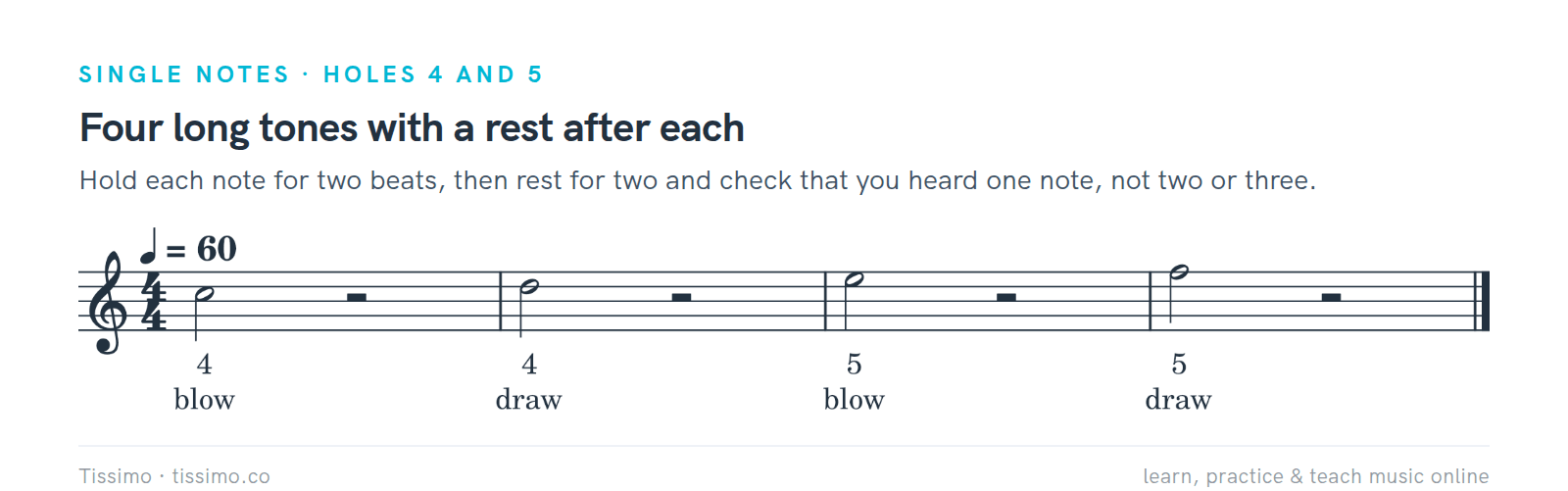
Two beats of sound, two of silence. Use each rest to check: was that one note? If you heard a neighbor too, push the lips forward a little before the next one.
If a low draw note sounds flat or won't sound at all, HOHNER's FAQ says the cause is often technique, not a faulty harmonica. Its advice: breathe gently through the harmonica instead of sucking, open the jaw and keep the throat open. You will need that for holes 1 to 3 later.
Each note and each rest in that exercise lasts two beats: The half note and The Rests explain the two signs, and The quarter note covers the one-beat value the tunes use most.
Next, change holes without changing the breath: slide the harmonica, keep the lips where they are.

One breath direction per bar. If a neighbor sneaks in on the way, slow down and keep the opening small.
How harmonica music is written
Harmonica tablature, or tab, gives the hole and the breath for every note. The hole is always a number; the breath is marked differently in different books. Tissimo's worksheets spell out BLOW and DRAW, or put B and D under the hole number with a legend. The Harmonica For Dummies cheat sheet uses an arrow pointing up for exhale and down for inhale. Some online tabs, such as Harmonica.com's guide, write a plain number for blow and a minus for draw, so "-4" is 4 draw. In a BluesHarmonica.com forum reply, Yerxa lists more: the teacher David Barrett puts a plus after blow notes, and another teacher circles the draw notes. Barrett explains his system himself: a plus for blow and nothing for draw, so there a plain "4" is 4 draw.

Five ways to write the same two notes. The hole number never changes; only the breath sign does.
So read the legend before you play anything. A plain "4" is a blow note in one system and a draw note in another.
The staff adds what plain tab leaves out: how long each note lasts. In the figures here, the notes give pitch and rhythm and the two label lines give hole and breath. If the staff is new, How to Read Sheet Music walks through it and The Musical Alphabet explains the letter names. For a full reading drill on holes 4 to 6, see C Harmonica Holes 4–6: Read Blow and Draw; Name the Note, Plan the Breath tests the same skill in three steps, ending with two written routes to complete and repair.
The C major scale in holes 4 to 7
Holes 4 to 7 hold one complete C major scale, from C5 to C6. Going up, holes 4, 5 and 6 each give blow, then draw. Then the pattern flips: hole 7 gives draw first, B5, and blow second, C6. If you blow 7 expecting B, you get C, because hole 7 is the first hole where the blow note is the higher one.
Before the whole scale, play the two new holes as long tones.

The same long tones one step higher. In hole 7 the draw note comes first: B5, then C6.
Then play the whole scale slowly, one note per click. The breath alternates almost all the way; the one exception is where 6 draw and 7 draw sit side by side.

Up and down the scale. Notice the two places where the hole stays the same and only the breath changes for a half step: hole 5 and hole 7.
The scale follows the recipe of every major scale, whole, whole, half, whole, whole, whole, half, which The major scale shows on the keyboard and The Major Scale, Step by Step explains. On the harmonica both half steps stay in one hole: 5 blow to 5 draw, and 7 draw to 7 blow.
Three first tunes
These three tunes are original, written for this guide, in 4/4 at quarter note = 72, and all end on C5, 4 blow, the home note in the key of C. Tempo & the Metronome shows how to set a click and raise it in small steps; How to Practice With a Metronome has more.
The first tune stays in holes 4 and 5.

"Two-Hole Walk." Bar 1 moves between holes 4 and 5; bar 2 stays in hole 5 and changes only the breath.
The second tune adds hole 6 and two rests. Stop the breath on each rest and start again exactly on the next beat.

"Question and Answer." Bars 1 and 3 ask, ending on a rest; bars 2 and 4 answer with a held note.
The third tune climbs to C6 and uses hole 7 in both orders: draw then blow in bar 2, then blow then draw across the bar line into bar 3 and again at the start of bar 5.

"Over the Top." The comma after bar 4 is a breath mark. Once the tune is comfortable, play it from the staff with the labels covered.
Bar 4's G5 is a whole note: hold 6 blow for four full beats. The whole note has a short exercise in keeping time through a long note. You have been breathing out for most of four bars by then, so at the comma lift the harmonica just clear of your lips, take a quick breath, and come back in on 7 blow; a breath taken through the holes would sound a draw note.
Later, not now: bending and second position
Two techniques give the harmonica its blues sound, and you will hear about both early. They are worth knowing by name, and both are best learned with a steady single note already in place.
Bending lowers a note's pitch by changing the shape of your mouth and throat. Steve Baker's explanation for HOHNER gives the rule: the higher note of each hole is the one that bends down, so the draw notes in holes 1 to 6 and the blow notes in holes 7 to 10. Wikipedia calls it notoriously difficult and frustrating for beginners, and HOHNER's FAQ advises against bending heavily on a new harmonica.
Second position, or "cross harp," means playing in the key of the draw chord: on a C harmonica, G, with 2 draw, G4, as home. Wikipedia notes it is the more common way to play blues and rock, and Baker points out that the F in 5 draw, the lowered seventh of G, becomes a "blue note" there. The G blues scale also needs B♭ and D♭, which aren't on an unbent C harmonica; they come from bends, which is why the two techniques go together.

The same C harmonica with two home notes. To play cross harp with a band, choose a harmonica a perfect fourth above the song's key.
Baker's rule for choosing a harmonica: an A harmonica to play in E, a D harmonica to play in A. By the same rule, The 12-Bar Blues, written in C, would need an F harmonica for cross harp.
A four-week start and looking after the harmonica
The plan below uses about ten minutes a day. It is a suggested pace, not a deadline: stay on a week until its last line is true. In week 2, do Name the Note, Plan the Breath on paper before you play its routes.

A four-week start. Every week ends with a check you can hear.
After week 4, try finding a melody you know by ear in holes 4 to 7: How to Play by Ear gives six steps for working out a tune.
Four care habits from HOHNER's FAQ, shown below: before you play, rinse your mouth, skip sugary drinks and warm the harmonica in your hands; while you play, keep the volume moderate, especially on a new harmonica; afterward, tap it out against your palm, holes down, wipe it and let it dry before casing it; and never rinse the assembled harmonica in water, soak it or put it in the dishwasher.

Four habits that keep the reeds working. HOHNER advises letting its low-tuned models, in keys below a standard G harmonica, air-dry instead of tapping them out.
Free worksheets for this guide
The two harmonica sheets are written for this instrument. The rhythm and theory sheets use piano examples; the counting and the note values work the same way on harmonica.
- One Hole, Two Notes: C Harmonica — holes 4 to 6 as blow and draw pairs, with a four-bar model and audio
- Name the Note, Plan the Breath — name notes from hole and breath, then complete and repair two routes
- The major scale — the W W H W W W H recipe on the keyboard
- The quarter note — one beat per note, with a rhythm to tap
- The half note — two beats, counted through
- The whole note — four beats of steady time
- The Rests — quarter, half and whole rests, counted like notes
- Tempo & the Metronome — metronome marks and how to raise the speed in small steps
- The 12-Bar Blues — the twelve-bar map of I, IV and V7, shown in C
When a teacher helps
Most early harmonica problems happen inside your mouth, where you can't see them: a lip opening a little too wide, air leaking at the corners, a throat that tightens on the low draws. A teacher can often hear which one in a few notes. On Tissimo, browse the music teachers and ask whether a teacher takes harmonica students before you book a lesson.
Sources
- Harmonica Catalog, Tuning Charts — HOHNER
- FAQs: Harmonica — HOHNER
- Harmonica Terminology #2: Cross Harp, Straight Harp and Positions — Steve Baker, myHOHNER
- Harmonica Terminology #3: Bending & Overblowing — Steve Baker, myHOHNER
- Major Diatonic Harmonica — Lee Oskar Harmonicas
- Richter-tuned harmonica — Wikipedia
- Harmonica techniques — Wikipedia
- How to Hold and Position the Harmonica — Winslow Yerxa, Harmonica For Dummies
- How to Cup the Harmonica in Your Hands — Winslow Yerxa, Harmonica For Dummies
- How to Form the Pucker Embouchure on the Harmonica — Winslow Yerxa, Harmonica For Dummies
- Harmonica For Dummies Cheat Sheet — Winslow Yerxa
- How to Read Harmonica Tabs — Harmonica.com
- Different Harmonica Tabs — Winslow Yerxa, BluesHarmonica.com forum
- Question About Tab Notation — David Barrett, BluesHarmonica.com
Read this article online: https://tissimo.co/articles/harmonica-for-beginners-holes-single-notes-and-first-melodies




Comments